Loading... Please wait...
 USD
USD



Blog
Recent Posts
Princess Cut vs Radiant Cut: The Savvy Buyer’s Guide to Square Diamonds
Posted on
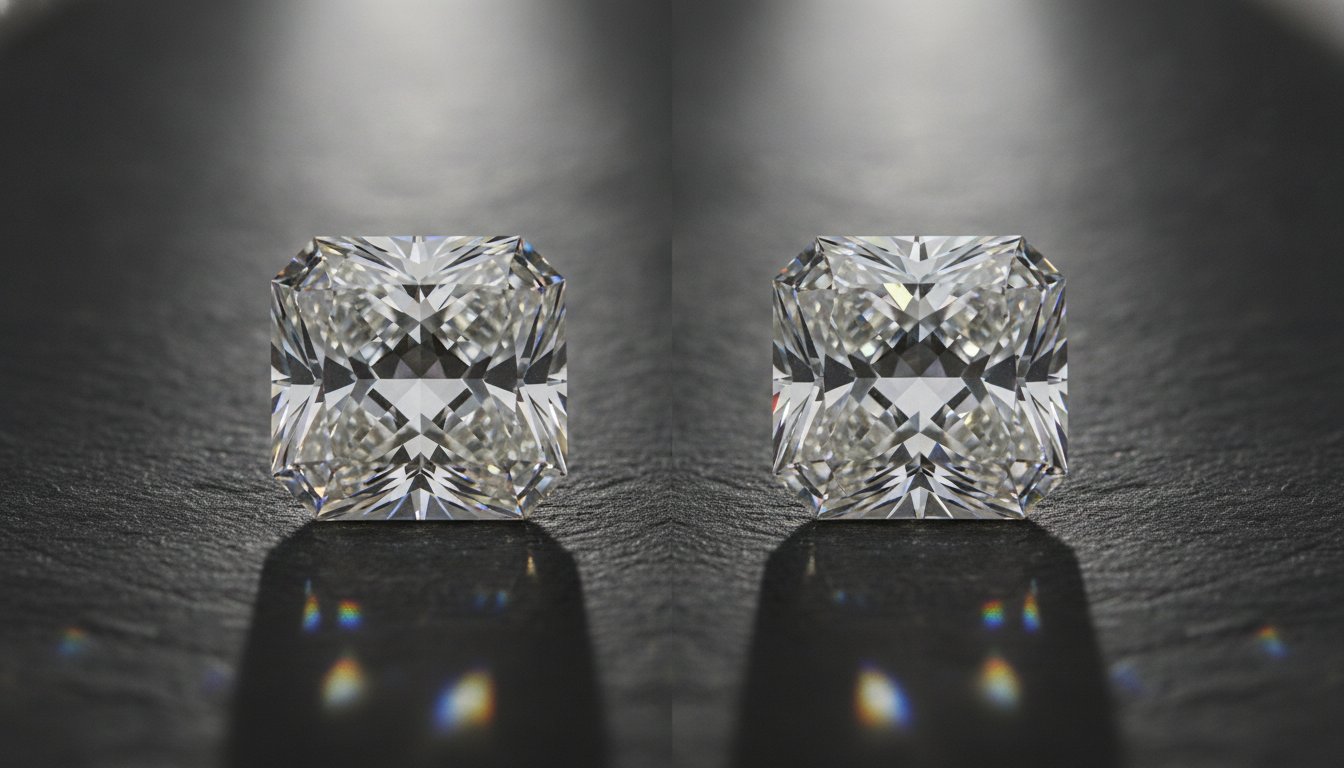
The sharpest corners in the diamond world might actually be your biggest liability when it comes to long-term value. Most buyers start their search looking for a classic square silhouette, but the debate of princess cut vs radiant cut often leads to more confusion than clarity. You likely want a stone that captures the light perfectly without worrying about accidental chips or feeling priced out of the size you truly desire. It's frustrating to feel like you have to sacrifice carat weight just to stay within a realistic budget for a natural, earth-mined diamond.
This guide explores the technical and aesthetic differences between princess and radiant cuts to help you find the perfect balance of sparkle, durability, and value. We'll show you why clarity-enhanced diamonds are the savvy secret to getting a 2-carat look on a 1-carat budget. Drawing on over 20 years of expertise, we'll explain the truth about "crushed ice" sparkle and show you how to use 360-degree videos and detailed "Special Comments" to buy with total confidence. You'll learn how to evaluate IGL-certified stones online and find a beautiful, natural diamond that fits your lifestyle perfectly.
Key Takeaways
- Contrast the geometric "X" light pattern of a Princess cut with the multidimensional "crushed ice" brilliance of a Radiant cut.
- Understand the durability benefits of trimmed corners on a Radiant cut compared to the vulnerable, sharp points of a Princess cut.
- Determine which option offers the best value for your specific budget when comparing a princess cut vs radiant cut.
- Explore how clarity-enhanced natural diamonds provide a savvy way to secure a 1.5-carat look for a 1-carat price.
- Learn to use high-definition 360-degree videos and "Special Comments" to evaluate a stone's visual quality before you buy.
Princess Cut vs Radiant Cut: The Modern Square Diamond Debate
Square and rectangular diamonds provide a distinct, architectural appeal that contrasts sharply with the classic round brilliant. For many buyers, the choice between a princess cut vs radiant cut represents a search for the perfect balance between geometric precision and maximum brilliance. These two shapes dominate the market for square-shaped engagement rings, yet they offer very different visual experiences and practical benefits. Understanding these nuances is the first step toward finding a natural diamond that fits your lifestyle and your budget.
The Princess cut is a square brilliant cut that first gained prominence in the late 20th century. It's recognized by its sharp, un-trimmed corners and a facet pattern that creates a distinct "X" shape when viewed through the table. In contrast, the Radiant cut was the first diamond shape to successfully combine the elegant silhouette of an emerald cut with the intense sparkle of a round brilliant. Created in 1977, it features trimmed corners and a "crushed ice" facet pattern that hides inclusions remarkably well. This makes both cuts excellent candidates for those seeking high-impact sparkle in a non-round shape.
The Silhouette: Square vs. Rectangular
A primary difference between these two cuts lies in the length-to-width ratio. A Princess cut is almost exclusively cut as a perfect square, typically maintaining a ratio between 1.00 and 1.05. If a stone leans too far into a rectangular shape, it's generally considered a poorly cut Princess. Radiant cuts offer more flexibility. They can be perfectly square or elongated into a sleek rectangular shape. Elongated Radiants often create the illusion of a larger stone on the finger, making them a popular choice for those who want to maximize visual size. Square silhouettes tend to look best on hands with longer, slender fingers, while elongated shapes can help lengthen the appearance of the hand.
A Brief History of Modern Sparkle
The Princess cut rose to fame in the 1980s as the premier "modern" alternative to the round diamond. Its popularity stems from its ability to retain more of the original rough diamond's weight during the cutting process. This efficiency often translates to a lower price per carat for the consumer. The Radiant cut was engineered with a different goal. Its inventor, Henry Grossbard, wanted to maximize light return in a shape that could also mask natural inclusions. This engineering makes the Radiant cut an excellent candidate for clarity enhancement. The complex facet pattern works in harmony with the enhancement process to deliver a visually stunning natural stone. You get the size you want without the high-clarity price tag, which is a core part of being a savvy diamond buyer.
Sparkle and Fire: Comparing Facet Patterns and Light Return
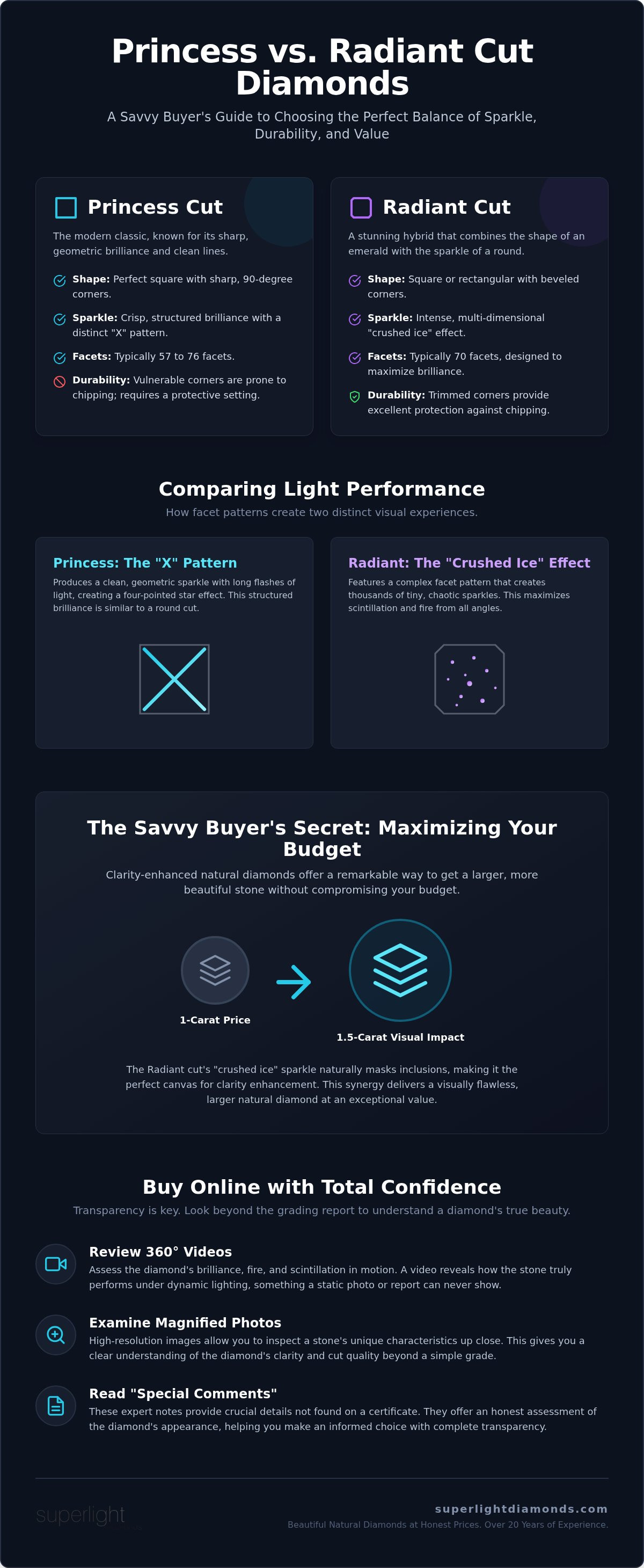
When comparing a princess cut vs radiant cut, the most striking difference is how they interact with light. A Princess cut produces a distinct four-pointed star or "X" pattern across its table. This look is crisp, geometric, and structured. Radiant cuts offer what experts call a "crushed ice" effect. This means the sparkle is more chaotic and multidimensional, looking like thousands of tiny mirrors reflecting light at once. It's a look that appeals to those who want a diamond that truly dances under any lighting condition.
Brilliance refers to white light return, while fire is the flash of spectral colors. Princess cuts lean toward brilliance, mimicking the linear sparkle of a round diamond. Radiants excel at scintillation, which is the twinkling effect seen when you move your hand. The depth of the stone is critical here. A diamond that is too deep will look "dead" or dark in the center. This happens because light leaks out the bottom instead of reflecting back to your eye. Conversely, a stone that is too shallow won't have the internal reflections needed for a vibrant personality.
Facet Structure of the Princess Cut
The Princess cut typically features 57 to 76 facets arranged in a pyramid-like pavilion. This specific arrangement allows for high light return, but it requires excellent symmetry to maintain its sharp appearance. Understanding how to select a princess cut diamond involves looking for balanced proportions that ensure the "X" pattern is centered and bright. In a princess cut vs radiant cut comparison, the Princess will always offer a more traditional, structured brilliance that mimics the performance of a round stone.
The Radiant Cut’s Complex Faceting
Radiant cuts use a more complex system of 70 facets. This design combines the elegance of step-cut styles with the fire of brilliant faceting. This complexity is the Radiant cut's superpower for hiding microscopic natural inclusions. Because there is so much "action" within the stone, the eye focuses on the sparkle rather than any internal characteristics. This makes it a perfect candidate for clarity enhancement. This process allows you to prioritize a larger stone without sacrificing visual beauty. If you want to see this effect in action, you can browse our natural radiant diamonds to compare these light patterns yourself. We provide high-definition 360-degree videos of every stone, so you can see exactly how the light dances across the facets before you make a decision.
Durability and Settings: Protecting Your Investment
Choosing between a princess cut vs radiant cut involves more than just comparing facet patterns. You must also consider how the diamond's physical structure handles the wear and tear of daily life. While diamonds are the hardest natural substance, they aren't indestructible. Their shape determines where they are most vulnerable to impact. This is particularly true for square silhouettes, where corner design plays a pivotal role in long-term durability. A stone that looks beautiful in a showroom must also be practical enough for decades of daily wear.
The girdle thickness is a key factor in overall stone strength. A girdle that is too thin, often called "extremely thin," acts like a serrated edge that can chip easily. Savvy buyers look for a medium to slightly thick girdle to ensure the stone remains secure in its setting. Because we specialize in natural, earth-mined diamonds, we focus on providing stones with structural integrity that justifies your investment. Checking the girdle and corners is a vital step in the buying process.
Princess Cut Corner Protection
The Princess cut is famous for its crisp, 90-degree corners. These sharp points are the stone's most delicate feature. Because the corners are so thin, they're prone to chipping if they strike a hard surface. This is why V-prong settings are the industry standard for this shape. These prongs wrap around the entire corner, acting as a protective shield. A chipped corner on a natural diamond is a serious issue. It can compromise the stone's structural integrity and may require professional recutting, which reduces carat weight. For those with highly active lifestyles, a bezel setting offers the ultimate security by encircling the entire perimeter of the diamond in metal.
Radiant Cut: The Practical Choice
Radiant cuts offer a hidden durability advantage. Their corners are beveled or "trimmed," meaning they lack the sharp, vulnerable points of a Princess cut. This design makes the Radiant cut far more resistant to chipping and less likely to snag on sweaters or delicate fabrics. Jewelers often find Radiants easier to set because the trimmed corners provide a more stable surface for standard prongs. Regarding the silhouette, the prongs on a Radiant cut are less obtrusive. They blend into the angled corners rather than defining the shape like they do on a Princess cut. This makes the Radiant cut a highly practical choice for daily wear.
Transparency is vital when evaluating durability online. You shouldn't rely solely on a grading report to judge a stone's physical condition. By reviewing 360-degree high-definition videos, you can inspect the corners and girdle of the exact diamond you are considering. Our specialized "Special Comments" on listings often highlight these physical traits, ensuring you buy a stone that is as durable as it is beautiful. This level of detail is essential when deciding on a princess cut vs radiant cut for your specific lifestyle.
Maximizing Your Budget: The Value of Clarity-Enhanced Diamonds
The final decision between a princess cut vs radiant cut often comes down to how much look you can get for your money. Many buyers feel they must settle for a smaller stone to stay within a realistic budget for a natural, earth-mined diamond. Clarity enhancement offers a savvy alternative. This permanent process targets natural inclusions that might be visible to the naked eye, making them invisible. The result is a visually stunning stone that retains its status as a 100% natural diamond. Unlike lab-grown stones, these were formed in the earth over millions of years and carry the prestige of a genuine gemstone.
The real advantage is the massive value proposition. Choosing a clarity-enhanced stone typically allows for a 30% to 50% increase in carat weight for the same price. This is the secret that lets you secure a 1.5-carat look on a 1-carat budget. Princess and Radiant cuts are particularly well-suited for this process. Their complex facet patterns and intense scintillation work in harmony with the enhancement to mask internal characteristics. This ensures the diamond remains eye-clean while delivering the size and sparkle you prioritize.
Comparing Costs: Natural vs. Clarity Enhanced
Paying a premium for microscopic purity is often a waste of resources for everyday wear. Most consumers prioritize eye-clean diamonds, meaning no inclusions are visible without magnification. Clarity enhancement focuses specifically on achieving this standard. By opting for an eye-clean stone, you redirect your budget toward the traits people actually notice: size and brilliance. It's a practical approach that prioritizes visual impact over arbitrary grading report statistics. This strategy is especially effective when evaluating a princess cut vs radiant cut, as both shapes are engineered to maximize light return and hide internal traits naturally.
The Superlight Advantage in Fancy Shapes
At Superlight Diamonds, clarity enhanced diamonds undergo rigorous quality checks to ensure they meet our standards for brilliance and durability. We don't hide behind generic stock photos or misleading descriptions. Every listing includes high-definition 360-degree videos and magnified photographs of the actual stone. Our IGL (International Gemological Laboratories) certifications are supplemented by our unique "Special Comments" section. These comments disclose characteristics that aren't always obvious from a grading report, allowing you to buy with total confidence. This transparency has helped us serve over 21,000 satisfied clients since 2001. If you're ready to see the difference for yourself, you can view our current inventory of square diamonds and find the perfect match for your budget.
Buying with Confidence: How to Select the Perfect Stone Online
Selecting a natural diamond online requires a shift in strategy. You should never purchase a princess cut diamond based on a grading certificate alone. Paper stats don't capture the "sparkle factor" or the way a stone interacts with light. High-definition 360-degree videos are the most powerful tool in your arsenal. They allow you to see the actual light return and scintillation of the specific stone you're considering. This visual evidence is far more reliable than a generic stock photo or a simple list of measurements.
Transparency is our priority. We provide "Special Comments" on every listing to disclose characteristics that a lab report might miss. This might include details about the specific nature of an inclusion or how it affects the stone's brilliance. When comparing a princess cut vs radiant cut, these details help you understand the unique personality of each natural stone. High-magnification photography also allows you to verify the "eye-clean" status for yourself, ensuring no inclusions distract from the diamond's beauty.
Interpreting the Grading Report
A grading report is a map, not the destination. For fancy shapes like Princess and Radiant cuts, you've got to look beyond the basic grades. The diamond color scale is a great starting point, but remember that these shapes can show color more than a round diamond. We typically use IGL (International Gemological Laboratories) certification to verify a stone's natural earth-mined origin. Since industry-standard "Excellent" cut grades are rare for fancy shapes, you should focus on the depth and table percentages. A depth between 65% and 75% for a Princess cut, or 60% to 70% for a Radiant, generally ensures a vibrant, well-proportioned stone.
The Superlight Auction Experience
Finding the best value often leads to our no reserve diamond auctions. This model ensures that pricing is driven by the current market rather than arbitrary retail markups. It's a transparent way to buy where you set the price. If you're bidding on loose stones, you can often save significantly compared to pre-set rings. Before you commit to a princess cut vs radiant cut, go through this final checklist:
- Review the 360-degree video to see the light performance in motion.
- Check the "Special Comments" for any non-obvious traits.
- Examine the high-magnification photos to confirm the stone is eye-clean.
- Verify the IGL certification data matches the listing description.
With over 20 years of experience and tens of thousands of satisfied customers, we've refined this process to make online diamond buying safe, transparent, and rewarding. You don't need a showroom to find a beautiful stone; you just need the right data and the visual proof to back it up.
Find Your Perfect Square Diamond Today
Choosing between a princess cut vs radiant cut doesn't have to be a compromise between beauty and budget. You've seen how the structured brilliance of the Princess cut offers a classic look, while the Radiant cut provides superior durability and a modern "crushed ice" sparkle. By opting for clarity-enhanced natural stones, you can prioritize the visual impact of a larger diamond without paying for microscopic traits that don't affect beauty.
At Superlight Diamonds, we believe in total transparency. Our 20 years of expertise and history of serving over 21,000 happy customers are built on providing the data you need to buy with confidence. Every listing features detailed "Special Comments" and high-magnification visuals so you know exactly what you're getting. As a top-rated eBay seller, our no-reserve auctions ensure you pay fair market value for every earth-mined stone.
Ready to see these stones in motion? View our actual 360° videos of Princess and Radiant Cut Diamonds and find a diamond that matches your lifestyle and your budget. Your perfect natural diamond is waiting.
Frequently Asked Questions
Which is more expensive, a princess cut or a radiant cut diamond?
Princess cuts often provide a lower price per carat because the cutting process retains a high percentage of the original rough stone's weight. Radiant cuts are similarly efficient, making both excellent value choices. When comparing a princess cut vs radiant cut, the most significant savings come from choosing clarity-enhanced options. These natural stones offer 30% to 50% better value, allowing you to prioritize size and brilliance within your specific budget.
Do princess cut diamonds look bigger than radiant cuts of the same carat weight?
Many Princess cuts have a larger table surface, but they're also quite deep, which can hide some of their carat weight. Radiant cuts, especially elongated versions, can create the illusion of a larger diamond on the finger. The visual size depends on the specific proportions of the stone. Savvy buyers use our 360-degree videos to judge the "face-up" size of the diamond rather than relying on carat weight alone.
Are clarity-enhanced diamonds safe for daily wear in an engagement ring?
Clarity-enhanced diamonds are 100% natural earth-mined stones and are perfectly safe for daily wear. The enhancement process is permanent and doesn't affect the diamond's structural integrity. These stones handle the rigors of an engagement ring just like any other natural diamond. We've served over 21,000 satisfied clients since 2001 who wear their enhanced diamonds with total confidence every single day.
Which cut has more sparkle: princess or radiant?
Both cuts offer exceptional brilliance, but they produce different types of sparkle. Princess cuts feature a structured, linear light pattern that mimics a round brilliant. Radiant cuts produce a "crushed ice" effect with multidimensional, chaotic flashes of light. When evaluating a princess cut vs radiant cut, the "best" sparkle is a matter of personal preference. Reviewing actual videos of each stone is the only way to determine which light pattern appeals to you.
Can I use a standard square setting for a radiant cut diamond?
Standard square settings designed for a Princess cut generally won't work for a Radiant diamond. Princess cuts have sharp 90-degree corners that require V-prongs for protection. Radiant cuts have trimmed or beveled corners that need a different prong arrangement to sit securely. Using the correct setting ensures the stone is protected from snagging or impact, which is vital for maintaining the longevity of your natural diamond.
What is the best length-to-width ratio for a square radiant diamond?
Ideal length-to-width ratios for a square radiant diamond fall between 1.00 and 1.05. If you prefer a slightly rectangular look, ratios between 1.10 and 1.20 are common. The ratio significantly impacts the diamond's silhouette and how it sits on the finger. We provide the exact measurements for every stone in our inventory, allowing you to choose the specific proportions that match your aesthetic and visual goals.
Why does Superlight Diamonds use IGL certification instead of GIA?
Choosing IGL certification provides objective, detailed data that supports our value-driven business model. IGL is a respected global authority that accurately verifies a stone's natural earth-mined origin and clarity-enhanced status. By focusing on visual beauty and honest certification rather than paying for a specific lab's brand name, we pass significant savings on to our customers without sacrificing transparency or quality.
How do I know if a clarity-enhanced diamond is "eye-clean" when buying online?
Visual transparency is achieved through highly magnified photographs and 360-degree high-definition videos of every unique diamond. These tools allow you to inspect the stone far more effectively than a grading certificate alone. Our "Special Comments" section also discloses traits that aren't obvious from a report. This combination of visual proof and expert disclosure ensures you can verify the "eye-clean" status and buy with total confidence.