Loading... Please wait...
 USD



Blog
Recent Posts
VS2 vs. SI1 Diamond Clarity for Budget Buyers: How to Choose
Posted on
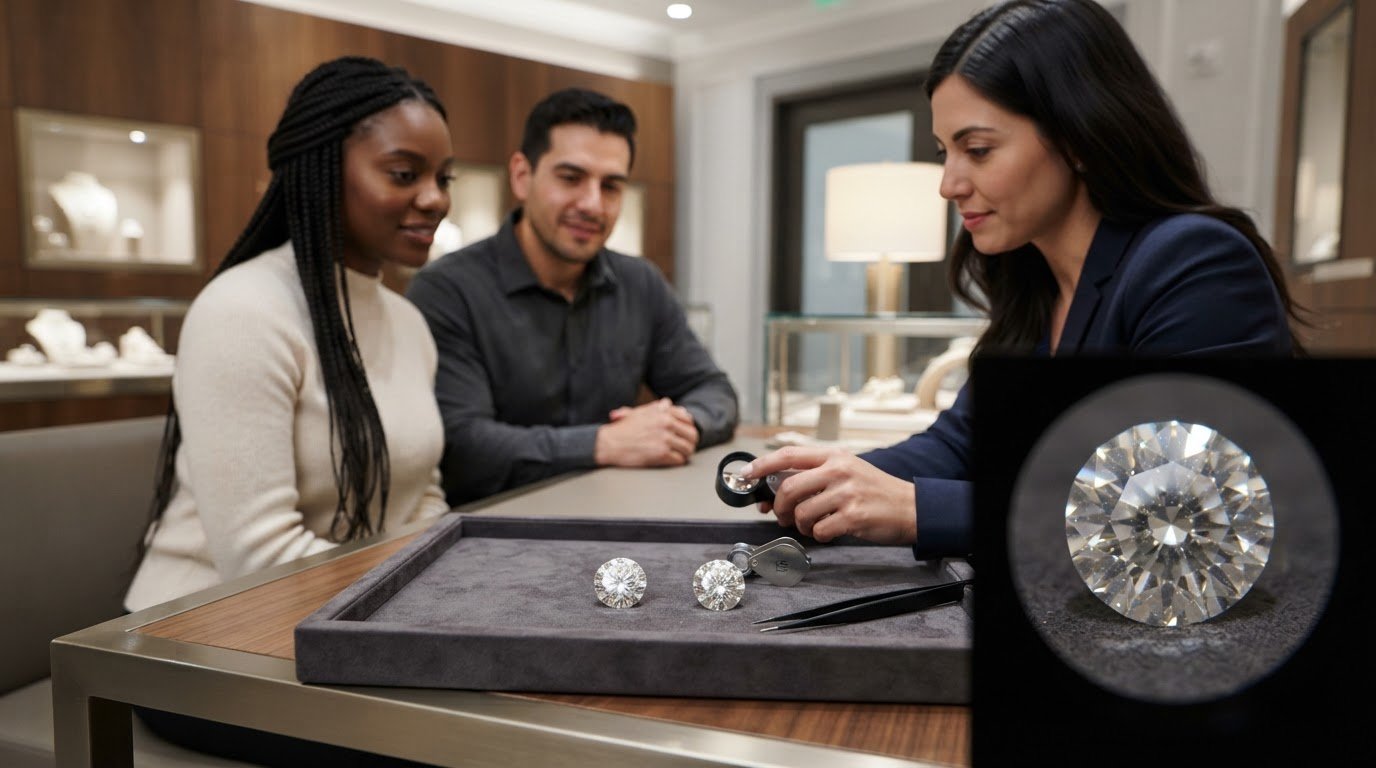
The higher clarity grade isn’t automatically the better buy. If you’re weighing VS2 vs SI1 diamond clarity for budget buyers, it’s reasonable to wonder whether an SI1 inclusion will be visible or whether VS2 is worth the added cost. The grade describes what a grader sees under magnification, but it can’t tell you exactly how a particular diamond will look to your eye.
In this guide, we explain what VS2 and SI1 mean, which inclusion details to examine, and how a characteristic’s position can affect its visibility. Superlight Diamonds specializes in natural earth-mined diamonds, with honest disclosures to help you compare individual stones. Most of our inventory consists of clarity-enhanced natural diamonds. This disclosed process is separate from the clarity grade. Highly magnified photographs, 360° videos, and detailed Special Comments let you examine the exact diamond and weigh its appearance against your budget.
Key Takeaways
- VS2 and SI1 describe clarity characteristics, but the grade alone can’t guarantee how a diamond will look to you.
- For VS2 vs SI1 diamond clarity for budget buyers, compare the exact stone’s inclusion type, location, and visibility before deciding.
- Use the diamond’s report alongside its actual appearance to weigh clarity against priorities such as size and budget.
- Superlight Diamonds specializes in natural earth-mined diamonds and provides clear disclosures to help you make an informed choice.
VS2 vs. SI1 Diamond Clarity: What the Grades Tell Budget Buyers
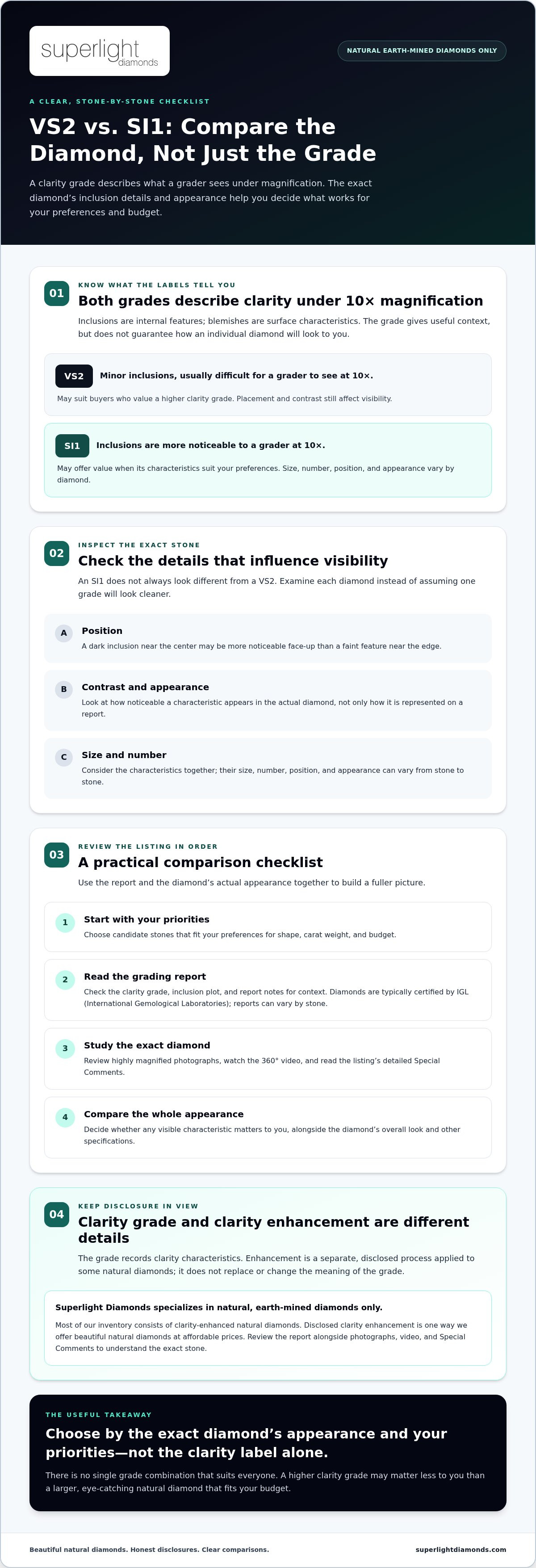
For VS2 vs SI1 diamond clarity for budget buyers, the key difference is how noticeable a diamond’s clarity characteristics are under magnification. VS2 means a grader sees minor inclusions, usually with difficulty at 10× magnification. SI1 means inclusions are more noticeable to a grader at that magnification. Both grades can include internal features, called inclusions, and surface characteristics, called blemishes. The Diamond Clarity Grading Scale provides a broader explanation of these grades.
A grade helps you narrow your options, but it doesn’t predict exactly what you’ll see in everyday viewing. Compare the actual stone’s images and details, paying particular attention to the inclusion’s position, contrast, and appearance. Here’s a quick comparison:
| Grade | What it means | Typical buyer consideration | Why the exact stone matters |
|---|---|---|---|
| VS2 | Minor inclusions, difficult for a grader to see at 10× | May suit buyers who value a higher clarity grade | Inclusion placement and contrast still affect visibility |
| SI1 | Inclusions more noticeable to a grader at 10× | May offer value if its characteristics suit your preferences | Size, number, position, and appearance vary by diamond |
Does SI1 always look different from VS2?
No. Inclusion size, position, number, and contrast all influence whether a characteristic catches your eye. For example, a dark inclusion near the center may be more noticeable face-up than a faint feature near the edge. Graders assess clarity under magnification, while buyers often judge a diamond face-up in ordinary viewing conditions. A clarity grade alone can’t predict how every individual diamond will look.
Compare the exact stone rather than assuming that every VS2 will look cleaner than every SI1. This can help you decide whether to prioritize the higher grade or choose an SI1 whose visible characteristics suit your preferences and budget.
How to Compare a VS2 and SI1 Diamond Before You Buy
A useful comparison starts with the individual diamond, not an assumption about which grade must look better. For VS2 vs SI1 diamond clarity for budget buyers, follow a consistent review process:
- Select a candidate. Start with stones that fit your priorities for shape, carat weight, and budget.
- Read its grading report. Check the clarity grade, inclusion plot, and report notes for context. Diamonds are typically certified by IGL (International Gemological Laboratories), though reports can vary by stone.
- Study the exact diamond. Review its highly magnified photographs and 360-degree video, then read the listing’s Special Comments.
- Compare the whole appearance. Consider whether any visible characteristic matters to you, alongside the diamond’s overall look and other specifications.
What to inspect in the exact diamond listing
An inclusion plot maps characteristics for reference, but it doesn’t show how prominent they appear in the actual stone. Magnified photographs help you examine their position and contrast, while a 360-degree video lets you view the diamond from changing angles. Special Comments may point out details that a grade label or report alone doesn’t communicate. Review all three rather than drawing a conclusion from the certificate by itself.
Clarity is only one part of your decision. Cut, color, and carat weight also shape the balance of appearance and budget, and there’s no single grade combination that suits everyone. For another perspective on color trade-offs, consult The Ultimate Diamond Color Scale Guide: Maximizing Beauty and Value in 2026. Superlight Diamonds’ listing details help you compare the exact natural earth-mined diamond. Browse our natural diamond selection to see the information available for each stone.
Choose a Natural VS2 or SI1 Diamond With Clear, Honest Disclosure
A clarity grade and clarity enhancement describe different things. The grade records a diamond’s clarity characteristics; enhancement is a separate, disclosed process applied to some natural diamonds. It doesn’t replace or change the meaning of the grade, so consider both pieces of information when comparing a stone.
How transparency helps you compare with confidence
Superlight Diamonds specializes in natural earth-mined diamonds, and most of our inventory consists of clarity-enhanced natural diamonds. Clarity enhancement is one way we offer beautiful natural diamonds at affordable prices. Clear disclosure helps you understand the diamond you’re considering and compare its characteristics with other stones.
Each listing’s information can fill in details a grade alone can’t convey. Highly magnified photographs show the exact diamond’s clarity characteristics up close, while its 360-degree video lets you view the stone from different angles. Detailed Special Comments may call attention to characteristics that aren’t obvious from a grading report. Use these alongside the report, not as a substitute for it, to form a fuller picture of the individual stone.
For a deeper explanation of the process, see Clarity Enhanced Diamonds: The Savvy Buyer’s Guide to Natural Brilliance. Considering enhancement separately from the VS2 or SI1 grade makes it easier to compare both the diamond’s documented clarity and its visible appearance.
There’s no universal grade that delivers the best value for every buyer. Compare individual listings, review their disclosures, and decide which diamond’s appearance and details fit your priorities. Paying for a higher clarity grade may not be as important to you as choosing a larger, eye-catching natural diamond within your budget.
Make Your Choice With Confidence
The best fit isn’t determined by a clarity label alone. Use your priorities to decide which exact diamond offers the appearance and balance you want, then review its listing disclosures before choosing. That’s a practical approach to VS2 vs SI1 diamond clarity for budget buyers, especially when deciding how to allocate your budget across clarity, carat weight, color, and cut.
Superlight Diamonds specializes in natural earth-mined diamonds. Founded in 2001, we bring more than 20 years of experience and have served over 21,000 satisfied clients. We pair honest disclosures with competitive pricing and one of the largest online selections of natural loose diamonds.
Ready to compare individual stones at your own pace? Explore our natural loose diamond selection and choose the one that fits your priorities. Review the photographs, 360-degree video, and Special Comments alongside the grading report to make a considered choice.
Frequently Asked Questions
Is an SI1 diamond always visibly included to the naked eye?
No. Some SI1 inclusions may be difficult to notice without magnification, while others stand out more, depending on the stone and viewing conditions. For VS2 vs SI1 diamond clarity for budget buyers, consider how the diamond looks at a normal viewing distance as well as up close. Bright or changing light and different viewing angles can affect what you notice.
Can inclusions affect a diamond’s durability?
Yes, certain inclusions can be relevant to durability, particularly if a feature reaches the surface or is positioned where the diamond may be more vulnerable to impact. The clarity grade alone doesn’t indicate how resistant a stone is to damage. Review the individual report and listing disclosures, and consider the inclusion’s position and characteristics rather than judging by the SI1 or VS2 label alone.
What does an IGL diamond report tell a buyer about clarity?
An IGL report identifies the diamond’s assigned clarity grade and may include a plot showing the location of clarity characteristics. It helps you understand the grader’s assessment, but it can’t show exactly how noticeable a feature will be in ordinary viewing. Reports can differ in the details they provide, so use the specific report together with the diamond’s listing information.