Loading... Please wait...
 USD
USD



Blog
Recent Posts
Cushion Cut Diamond vs. Round: Which Shape Offers the Best Value in 2026?
Posted on
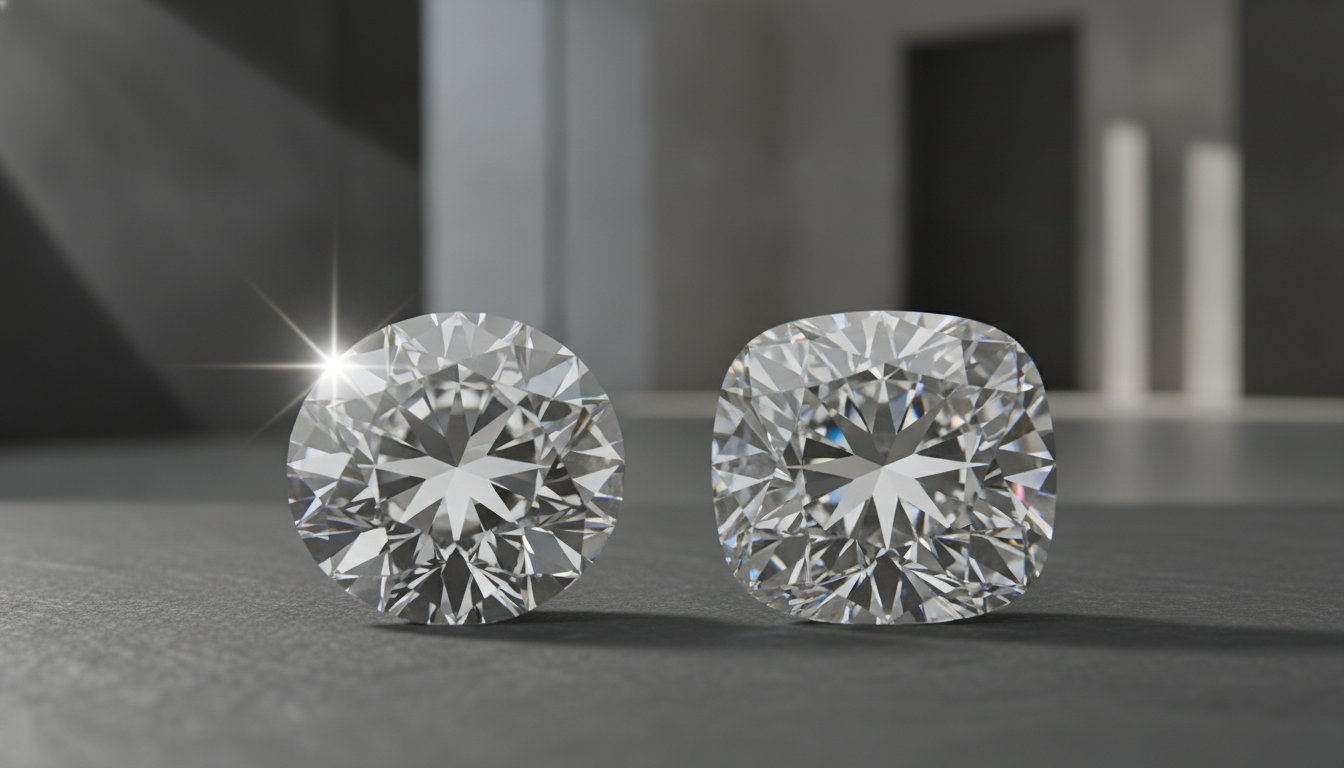
Choosing the most expensive diamond shape doesn't always mean you're getting the most impressive stone for your finger. When you evaluate a cushion cut diamond vs round, you might feel that the round brilliant is the only way to guarantee a classic look, but that premium price tag often forces you to settle for a smaller carat weight. It's frustrating to feel like you're paying for a "standard" rather than the actual beauty and size of the gem.
We understand that comparing these shapes can feel overwhelming, especially when technical terms like "crushed ice" or "brilliant" enter the conversation. This article will show you how to maximize your budget by choosing the right cut for your priorities. You'll learn which shape offers a larger face-up appearance and how our clarity-enhanced natural diamonds provide a stunning look at significantly lower prices than traditional retail. We'll also explain why reviewing our 360-degree videos and "Special Comments" is more important for your satisfaction than any grading certificate alone. By the end, you'll know exactly how to find a diamond that looks massive and fits your budget perfectly.
Key Takeaways
- Identify the visual differences between the symmetrical round brilliant and the soft, pillow-like corners of the cushion cut.
- Evaluate the price per carat of a cushion cut diamond vs round to find out how to save significantly on a natural stone of the same weight.
- Learn why a round diamond often looks larger face-up and how a cushion cut carries its weight differently.
- Master the art of online shopping by prioritizing magnified 360-degree videos and detailed listings over a basic grading certificate.
- Discover how clarity-enhanced natural diamonds help you maximize your budget for a stone that looks impressive on the hand.
Understanding the Silhouette: Round Brilliant vs. Cushion Cut Diamonds
When you begin comparing a cushion cut diamond vs round, you're essentially choosing between two distinct philosophies of light and shape. The round brilliant is a masterpiece of modern precision engineering, while the cushion cut offers a softer, more historical character. Both are excellent choices for natural earth-mined diamonds, but they appeal to different aesthetic preferences and budget strategies. Understanding how these silhouettes behave is the first step toward finding a stone that looks impressive on the hand without overextending your finances.
The Timeless Appeal of the Round Brilliant
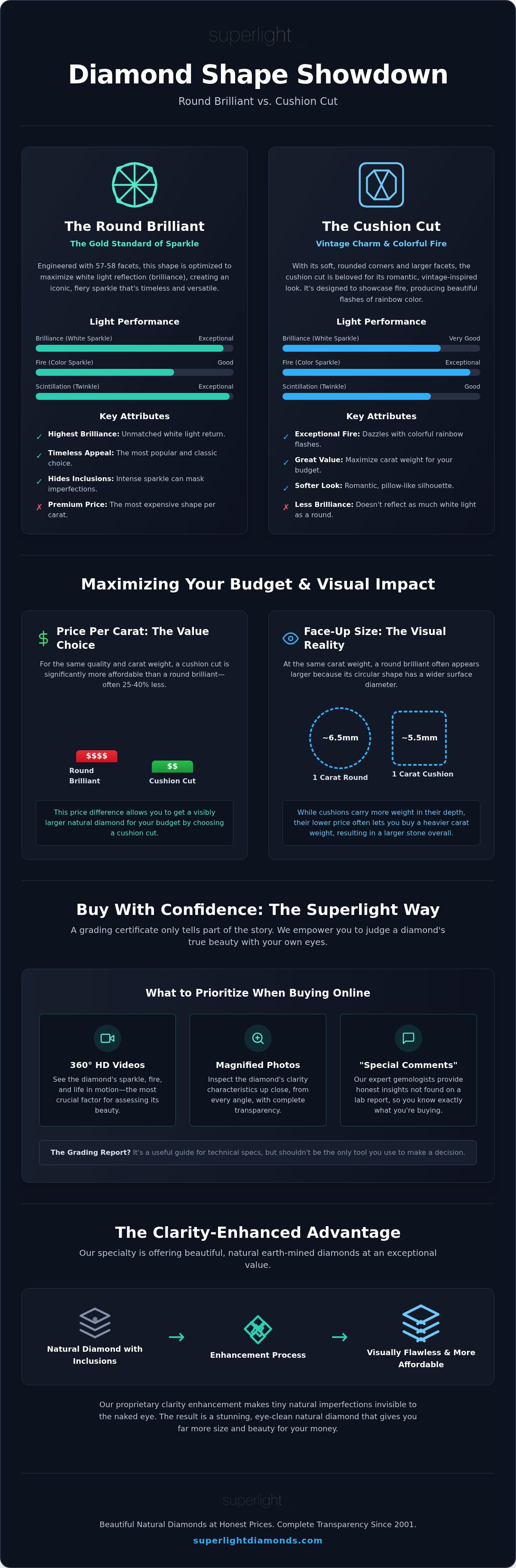
The round brilliant is often considered the gold standard of the diamond industry. It's engineered with 57 or 58 facets specifically positioned to maximize white light reflection, which gemologists call brilliance. This shape has remained the most popular choice for engagement rings for decades because its symmetrical circular outline fits almost any setting style. Because the industry uses a standardized grading scale for rounds, it's often easier for buyers to compare stones based on their proportions. However, this popularity comes at a premium. At Superlight Diamonds, we help you navigate this by offering clarity-enhanced rounds that provide that iconic sparkle at a much more accessible price point than traditional non-enhanced stones.
The Soft Romance of the Cushion Cut
If you prefer a vintage-inspired look, the cushion cut is a compelling alternative. This shape features rounded corners and curved sides that resemble a pillow, which is where it gets its name. It's a modern evolution of the historic "Old Mine" cut that was popular during the 19th century. One of the standout features of a cushion cut is its ability to produce fire, or flashes of colored light. Unlike the uniform brilliance of a round, cushions often have larger facets that create a unique, shimmering effect. You can find them in perfectly square ratios or slightly elongated shapes, allowing you to choose a silhouette that best complements the wearer's finger shape.
While the silhouette is your first decision, the technical grading report doesn't tell the whole story. Whether you choose a cushion cut diamond vs round, the true beauty lies in how the stone looks in motion. This is why we provide highly magnified 360-degree videos and detailed "Special Comments" for every listing. Since 2001, we've helped over 21,000 clients see past the certificate to find a natural diamond that truly shines. We believe you shouldn't pay for microscopic details you can't see; instead, focus on the overall silhouette and sparkle that fits your personal style.
The Sparkle Factor: Brilliance, Fire, and Light Performance
Sparkle is often the first thing people look for, but it's actually a combination of two distinct light effects: brilliance and fire. Brilliance is the reflection of white light, while fire refers to the rainbow-colored flashes that dance across the facets. When you evaluate a cushion cut diamond vs round, you'll find that each shape prioritizes these effects differently. Understanding this balance helps you choose a stone that matches your personal taste for light play.
Round diamonds are specifically engineered to maximize brilliance. Their symmetrical facet pattern ensures that light entering the stone is reflected back to your eye with high intensity. This intense white light return is excellent for hiding small natural inclusions. For those interested in our clarity-enhanced natural diamonds, the round shape is a strategic choice. The sheer volume of sparkle often masks the enhancement process, resulting in a stone that looks remarkably clear to the naked eye. You can view our current inventory of clarity-enhanced diamonds to see this light performance in action through our magnified 360-degree videos.
Why Rounds Win on Scintillation
The circular geometry of a round brilliant allows for an even distribution of light across the entire surface. This creates high scintillation, which is the "twinkle" you see when the diamond or the viewer moves. Because round diamonds reflect light so efficiently, they often appear brighter from a distance than other shapes. This makes them the ideal selection for someone who wants their diamond to be noticed from across a crowded room.
Cushion Cuts and the 'Crushed Ice' Effect
Cushion cuts offer a different visual experience by leaning into fire and warmth. While they don't have the same white-light intensity as a round, they excel at producing vibrant, colorful flashes. Modern cushion cuts are frequently designed with a "crushed ice" look. This means they have many small, shimmering facets that create a continuous, needle-like sparkle. Alternatively, some cushions feature broader facets that produce larger, bolder blocks of light. Choosing between a cushion cut diamond vs round often comes down to whether you prefer the sharp, surgical brilliance of a round or the romantic, glowing fire of a cushion. By reviewing our "Special Comments" on each listing, you can confirm exactly which sparkle style a specific stone possesses before you buy.
Maximizing Your Budget: Price Per Carat and Visual Size Reality
Your choice between a cushion cut diamond vs round isn't just about the silhouette; it's a strategic financial decision. Round diamonds consistently command the highest price per carat in the gemstone market. This price gap exists because cutting a round brilliant results in the most significant loss of rough diamond material. On average, you'll find that cushion cuts are 25% to 40% less expensive than rounds of identical carat weight, color, and clarity. This price difference allows you to redirect your funds toward a larger center stone or a more elaborate setting.
The Premium of the Round Cut
Manufacturers often lose up to 60% of the original rough diamond when creating a round brilliant. Because of this high manufacturing waste and overwhelming consumer demand, you're essentially paying a "popularity tax" for the round shape. If your goal is to maximize the physical dimensions of the stone on your finger, the round shape can be the most restrictive option for your budget. Savvy buyers often look toward fancy shapes like the cushion to get more diamond for their dollar.
How Clarity Enhancement Changes the Value Equation
At Superlight Diamonds, we believe you should prioritize what you can actually see on your hand rather than microscopic details on a grading report. Clarity-enhanced diamonds are 100% natural earth-mined stones that have undergone a specialized process to make eye-visible inclusions disappear. This approach completely reframes the cushion cut diamond vs round debate. By choosing a clarity-enhanced stone, you can often achieve a 2-carat look for the price of a traditional 1-carat diamond. This represents a 30% to 50% saving compared to non-enhanced diamonds of the same visual quality.
Transparency is vital when making this investment. We provide IGL certification and highly magnified 360-degree videos so you can evaluate the stone's beauty yourself. Our "Special Comments" section on each listing discloses specific details that a standard certificate might miss, ensuring you buy with complete confidence. You can explore our collection of natural clarity-enhanced diamonds to see how much more size and sparkle you can afford when you shop smart. Focusing on "buying the look" allows you to secure a stunning, impressive diamond that fits your lifestyle perfectly.
Practical Considerations: Face-Up Size and Setting Versatility
When you analyze a cushion cut diamond vs round, you must look beyond the carat weight and consider the physical dimensions in millimeters. Carat is a measure of weight, not size. Round diamonds are cut relatively shallow to maximize their diameter, giving them a larger face-up appearance. Cushion cuts carry a significant portion of their weight in their "belly", or depth, which is the portion of the stone hidden beneath the setting. This means two diamonds of the same weight can look very different in size once they are on your finger.
Round diamonds generally provide the most consistent visual impact because their circular shape spreads the weight evenly across the top of the stone. Choosing an elongated cushion is a smart alternative if you want to mimic the finger-covering effect of a larger diamond. These rectangular variations draw the eye up and down the finger, often creating a more flattering, lengthening effect than a standard square cushion or a round brilliant.
Does a 1-Carat Cushion Look Smaller Than a Round?
A standard 1-carat round brilliant typically measures approximately 6.5mm in diameter. In contrast, a 1-carat cushion cut often measures between 5.5mm and 6mm. To get the same visual impact as a 1-carat round, you usually need to step up to a 1.15 or 1.20-carat cushion. While this sounds like it would cost more, the lower price per carat of cushions makes this "upsizing" strategy very affordable. By choosing a clarity-enhanced cushion, you can afford a higher carat weight that matches the 6.5mm spread of a round brilliant while staying well within your budget.
To ensure you're getting the best visual value, we recommend ignoring the certificate's depth percentage and looking at the actual stone. Our magnified 360-degree videos allow you to see exactly how much "spread" a stone has before you commit. We also include precise millimeter measurements in our "Special Comments" section, so there are no surprises regarding the stone's physical size.
Choosing the Right Setting for Your Shape
Rounds work in almost any setting, from classic four-prong solitaires to intricate vintage designs. Their symmetry makes them incredibly versatile. Cushion cuts excel in halo settings, which feature a border of smaller diamonds around the center stone. This setting style emphasizes the soft corners of the cushion and adds significant visual size to the overall ring. For a more traditional look, four-prong settings are standard, but using double-claw prongs can enhance the vintage character of a cushion cut.
Settings can drastically change the perceived size of both shapes. A well-designed halo can make a 1-carat cushion look like a 2-carat stone to the casual observer. You can browse our collection of cushion cut diamonds to see how these stones look in various settings through our high-definition media. Whether you prefer the classic round or the romantic cushion, the right setting will help you maximize the beauty of your natural earth-mined diamond.
Buying with Confidence: How to Evaluate Your Diamond Online
Buying a diamond online can feel daunting, but the right digital tools make the process completely transparent. You should never buy a diamond based on a grading report alone. A certificate provides technical data, but it doesn't show beauty, character, or how the stone actually interacts with light. When you're comparing a cushion cut diamond vs round, seeing how the stone handles light in real-time is the only way to ensure you're getting a stone that looks impressive on the hand. Visual evidence is always more valuable than a list of grades on a piece of paper.
Moving Beyond the Grading Report
IGL certifications provide a reliable baseline for color and clarity, but your eyes should be the final judge. We encourage you to prioritize "eye-clean" stones. These are natural diamonds where inclusions are not visible to the naked eye, even if they're noted on a technical report. Instead of paying a massive premium for microscopic improvements in clarity that you'll never see, focus on the overall visual sparkle. You can learn more about selecting the right stone in our Guide to Buying Round Brilliant Loose Diamonds Online in 2026.
It's also helpful to ignore generic "Excellent" cut labels when shopping for fancy shapes like cushions. Unlike round diamonds, which have standardized proportions, cushion cuts vary wildly in their facet patterns and silhouettes. Some might have a "crushed ice" look while others have broader flashes. The only way to know which style you're getting is to watch the diamond in motion. This approach ensures you don't overpay for a "classic" shape when a value-driven alternative might actually offer the look you desire.
The Superlight Advantage: Magnified Photos and 360° Videos
Transparency is the foundation of our business model. Since 2001, we've served over 21,000 satisfied clients by providing high-resolution media for every stone in our inventory. Our magnified 360-degree videos allow you to see exactly how a diamond performs from every angle. You'll see the rainbow-colored fire in a cushion cut or the crisp white brilliance of a round stone as if you were holding it under a jeweler's loupe. This level of detail is essential for evaluating clarity-enhanced diamonds, as it lets you see the beautiful, eye-catching results of the enhancement process yourself.
We also include a "Special Comments" section on our listings. These notes are a crucial part of our commitment to honesty. They disclose specific characteristics that a standard grading report might miss, such as the exact nature of the stone's face-up measurements or its specific sparkle style. This level of detail empowers you to make an informed decision without needing to visit a physical showroom. By focusing on visual evidence and our detailed disclosures, you can secure a beautiful natural diamond that offers outstanding value. Our top-rated eBay status and two decades of experience mean you aren't just buying a stone; you're buying peace of mind and the most "face-up" size for your dollar.
Secure the Best Value for Your Natural Diamond
Deciding on a cushion cut diamond vs round ultimately comes down to your personal balance of light performance and budget. While round diamonds offer unmatched brilliance, cushion cuts provide a romantic, vintage aesthetic and a significantly lower price per carat. By choosing a clarity-enhanced natural diamond, you can maximize your visual impact and secure a larger stone than traditional retail allows. We believe in total transparency; that's why we provide magnified 360-degree videos and detailed "Special Comments" for every listing in our inventory.
With over 20 years of expertise and more than 21,000 satisfied customers, we've built our reputation on helping value-conscious buyers find stunning earth-mined diamonds at honest prices. You don't have to settle for a smaller stone just to stay within your budget. Take the next step in your journey and browse our current no-reserve diamond auctions on eBay to find an impressive stone that you'll be proud to wear. We're here to help you buy with total confidence and get the absolute most beauty for your dollar.
Frequently Asked Questions
Which is more expensive: a cushion cut or a round diamond?
Round diamonds are significantly more expensive than cushion cuts of the same carat weight. This price gap exists because cutting a round stone results in more rough diamond waste and faces higher consumer demand. You'll typically save 25% to 40% by choosing a cushion cut, which allows you to buy a much larger natural stone for the same investment.
Do cushion cut diamonds look smaller than round diamonds?
Yes, cushion cut diamonds often appear slightly smaller than round diamonds of the identical weight. Round diamonds are cut shallower to maximize their diameter, while cushion cuts carry more weight in their depth or "belly." To achieve the same visual impact as a 1-carat round, you should consider a cushion cut that's approximately 15% to 20% heavier in carat weight.
Which diamond shape sparkles the most?
Round diamonds generally produce the most brilliance, which is the intense reflection of white light. However, cushion cuts are famous for their "fire," or the ability to produce vibrant, rainbow-like flashes. Your choice depends on whether you prefer the sharp, surgical sparkle of a round brilliant or the warm, romantic glow typically found in a cushion cut.
Are clarity-enhanced cushion cut diamonds real diamonds?
Clarity-enhanced cushion cut diamonds are 100% natural earth-mined diamonds. They aren't lab-grown or synthetic stones. The enhancement process simply makes natural inclusions invisible to the naked eye. This allows you to own a beautiful, eye-clean natural diamond at a fraction of the cost of a non-enhanced stone with the same visual appeal.
Is a cushion cut diamond good for an engagement ring?
A cushion cut diamond is an excellent choice for an engagement ring, especially for those who appreciate a vintage or romantic aesthetic. Its soft, rounded corners make it less prone to chipping than square-cornered cuts like the princess cut. It's a durable and stylish option that pairs beautifully with halo or solitaire settings to create a timeless look.
What is the best setting for a cushion cut diamond vs. round?
Round diamonds are versatile enough for almost any setting, while cushion cuts are often best showcased in halo or vintage-inspired designs. A halo setting is particularly effective for cushions because it emphasizes their unique shape and adds significant visual size. When comparing a cushion cut diamond vs round for a setting, remember that rounds offer a classic silhouette while cushions provide a softer, more distinctive character.
Why are round diamonds so popular compared to cushion cuts?
Round diamonds remain popular because they're the industry standard for light performance and symmetry. Their iconic look has been the top choice for engagement rings for over a century. This high demand, combined with the fact that more rough material is lost during the cutting process, keeps their market price consistently higher than fancy shapes like cushions.
How can I get a bigger diamond for my budget?
You can get a much larger diamond for your budget by prioritizing clarity-enhanced natural stones and choosing a cushion cut over a round. This strategy often results in a cushion cut diamond vs round saving of 30% to 50% compared to traditional retail prices. Use our magnified 360-degree videos to find an eye-clean stone, ensuring you don't pay for microscopic details that aren't visible without a loupe.