Loading... Please wait...
 USD



Recent Posts
How a Diamond Cloud Inclusion Affects Brilliance
Posted on

Will a cloud inclusion noticeably reduce a diamond’s brilliance? It can, but the diamond cloud inclusion effect on brilliance depends on more than the word “cloud” on a grading report. A small, sparse cluster may be difficult to see, while a larger, denser one can create a hazy appearance, especially beneath the table. The report alone may not show how visible an inclusion is in the exact stone.
At Superlight Diamonds, we specialize exclusively in natural, earth-mined diamonds, including clarity-enhanced diamonds with transparent disclosures. This guide explains what clouds look like, how their size and position may affect sparkle, and what to assess before buying. Reviewing magnified photographs, 360° videos, and the individual diamond’s Special Comments can help you evaluate the exact stone.
Key Takeaways
- A cloud on a grading report doesn’t automatically mean a diamond will look dull. Judge its visible effect on the individual stone.
- The diamond cloud inclusion effect on brilliance depends on the cloud’s characteristics and the diamond’s overall appearance.
- Use the grading report as a starting point, then review magnified photos and the 360° video to assess the exact diamond.
- Compare the diamond’s appearance with your preferences and budget to make an informed choice.
What Is a Diamond Cloud Inclusion, and Can It Reduce Brilliance?
A cloud is a group of tiny inclusions, often pinpoints or small crystals, clustered close together within a diamond. Under magnification, the individual features may be difficult to distinguish, so they can appear as a hazy area. The Diamond Clarity overview explains how inclusions such as clouds are considered in clarity grading, but a grading term alone doesn’t show how the exact stone looks face-up.
Brilliance is the white light a diamond returns to the eye after light enters and reflects within it. It contributes to sparkle, but it isn’t the same as the diamond’s overall brightness or transparency. Brightness describes the general impression of light across the stone, while transparency relates to how clearly light passes through it. A dense cloud may make a diamond look hazy and less transparent, affecting its appearance, but its presence alone doesn’t establish the result.
Why some clouds are easier to notice than others
The cloud’s extent, density, and position all matter. A small cluster away from the center may be hard to notice face-up. A more extensive cloud beneath the table, the large facet at the top, may be more apparent. Lighting and viewing angle also influence what you see. A feature that stands out under magnification or in bright, direct light may be less noticeable in other conditions.
A cloud noted on a report is not, by itself, proof that a diamond looks dull. Judge the stone’s visible appearance, not just the inclusion’s name. At Superlight Diamonds, we specialize exclusively in natural, earth-mined diamonds and provide detailed information to help you assess each stone.
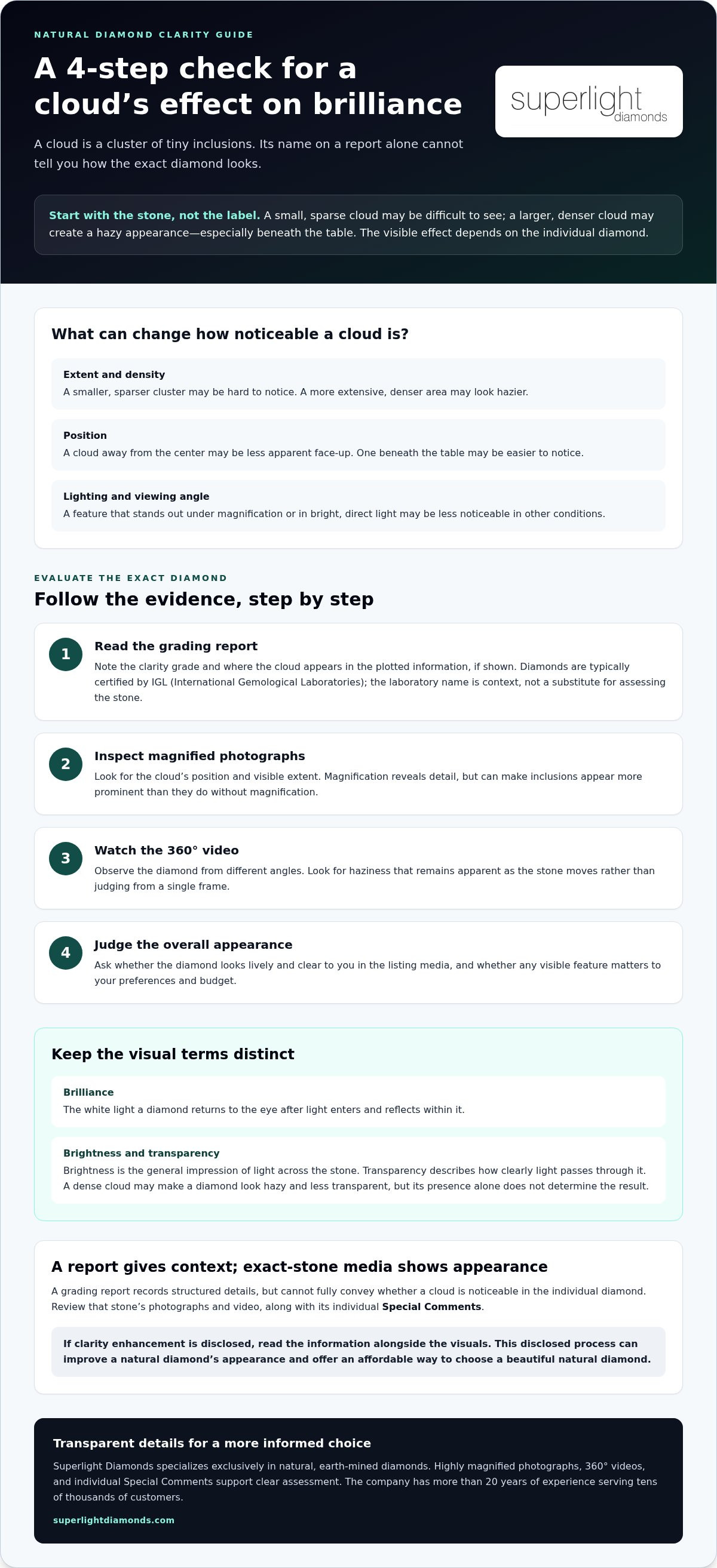
How to Assess a Cloud Inclusion’s Effect on Diamond Brilliance
To judge the diamond cloud inclusion effect on brilliance, use the report and listing media together. A report records grading information, but it can’t fully convey whether a feature is noticeable in the exact stone or changes its face-up appearance.
- Review the report. Note the clarity grade and where the cloud appears in the plotted information, if shown. Diamonds are typically certified by IGL (International Gemological Laboratories), but the laboratory name should not replace your own assessment of the diamond.
- Inspect the magnified photographs. Look for the cloud’s position and visible extent. Magnification reveals detail, but can make inclusions appear more prominent than they do without magnification.
- Watch the 360° video. Observe the diamond from different angles. Look for haziness that remains apparent as the stone moves, rather than judging from a single frame.
- Consider the overall appearance. Ask whether the stone looks lively and clear to you in the listing media, and whether any visible feature matters to your preferences.
What grading reports and diamond images each reveal
A report provides structured grading details; actual photographs and video help you evaluate how the individual diamond looks. A cloud description is useful context, not a standalone verdict on brilliance. Review media of the exact stone, since a general explanation or report can’t show its full visual character.
If the listing notes clarity enhancement, read the disclosure alongside the visuals. This disclosed process can improve a natural diamond’s appearance and offer an affordable way to choose a beautiful natural diamond. Understanding clarity-enhanced diamonds helps put treatment information in context. Superlight Diamonds provides highly magnified photographs, 360° videos, and individual Special Comments to support transparent decisions. Explore our natural diamond selection and review the details for each stone.
Choosing a Natural Diamond When a Cloud Appears in Its Grading Information
A cloud on a grading report isn’t an automatic reason to reject a diamond. Let the stone’s actual appearance, your preferences, and your budget guide the choice. If two diamonds both appeal to you, compare their overall look in the photos and videos, then decide whether any visible difference matters enough to affect your selection. The diamond cloud inclusion effect on brilliance is one consideration, not a verdict on the diamond’s beauty or value.
Use transparent details to compare the whole diamond
Weigh the diamond’s visible brilliance alongside its report and disclosed characteristics. A clarity grade can help you compare stones, but your priorities matter too. You may prefer a larger diamond that looks beautiful to you over paying more for a small grading difference you can’t see. For broader online assessment guidance, our round brilliant loose diamond buying guide offers useful context.
Exact-stone imagery helps you make a more informed choice than grading terminology alone. Superlight Diamonds offers a wide online selection of natural, earth-mined diamonds, competitive pricing, and honest disclosures. Browse natural diamonds and compare the details to find a stone whose appearance and value suit you.
Choose a Diamond with Confidence
Use what you’ve learned about the diamond cloud inclusion effect on brilliance to weigh the details that matter to you. Start with your priorities, compare the report with the exact diamond’s photographs and video, and consider whether any visible feature affects the look you want. Superlight Diamonds specializes exclusively in natural, earth-mined diamonds and brings more than 20 years of experience serving tens of thousands of customers.
Explore natural diamonds and compare each stone’s images, video, and disclosures to choose with confidence.
Frequently Asked Questions
Does a cloud inclusion automatically lower a diamond’s clarity grade?
No. A cloud’s presence alone doesn’t determine the clarity grade. Grading considers the diamond’s clarity characteristics as a whole, including how noticeable they are under examination. For example, a small cloud may have less influence than a larger or more visible inclusion. The report’s grade reflects an overall assessment, not a penalty assigned simply for the word “cloud.”
Can a cloud inclusion be identified from a grading report alone?
A grading report may identify a cloud in its clarity information, but it can’t show precisely how the feature looks to you. The diamond cloud inclusion effect on brilliance is a visual question as well as a grading one. Use the report to understand what was recorded, then examine the exact stone’s listing media to assess its appearance from different views.
Is a diamond with a cloud inclusion always visibly cloudy?
No. Some clouds are too small or faint to make the diamond look cloudy in ordinary viewing. When comparing stones, distinguish a feature you can spot only in a highly magnified view from a persistent milky or hazy appearance in the diamond itself. Your preference matters: a visible inclusion may be acceptable if the overall look appeals to you.