Loading... Please wait...
 EUR



Recent Posts
Is an I1 Clarity Diamond Ever Eye Clean? How to Choose
Posted on

A lower clarity grade doesn't automatically mean every inclusion is obvious at a glance. An I1 clarity diamond can sometimes appear eye clean, so the answer to whether an I1 clarity diamond is ever eye clean is yes, but visibility depends on the inclusions and where they sit.
It makes sense to be cautious: I1 diamonds can have inclusions that are visible without magnification, and the grade alone can’t tell you exactly how a particular stone will look. What matters is the diamond in front of you, not just its clarity label.
This guide explains what I1 clarity means, how an inclusion’s size, color, and position can affect what you see, and what to examine when choosing a diamond. You’ll come away with a practical way to judge whether a specific I1 stone suits your preferences and budget.
Key Takeaways
- An I1 grade signals noticeable inclusions, but their size, color, and position influence how visible they look.
- Pay close attention to inclusions near the center or a pointed tip, where they may catch the eye or create reflections.
- Judge a specific stone face-up and review its magnified photos, 360° video, and listing comments rather than relying on the clarity grade alone.
- Compare the diamond’s appearance with your budget and priorities; an I1 stone may suit you if its visible characteristics feel acceptable.
1. How inclusion location affects visibility
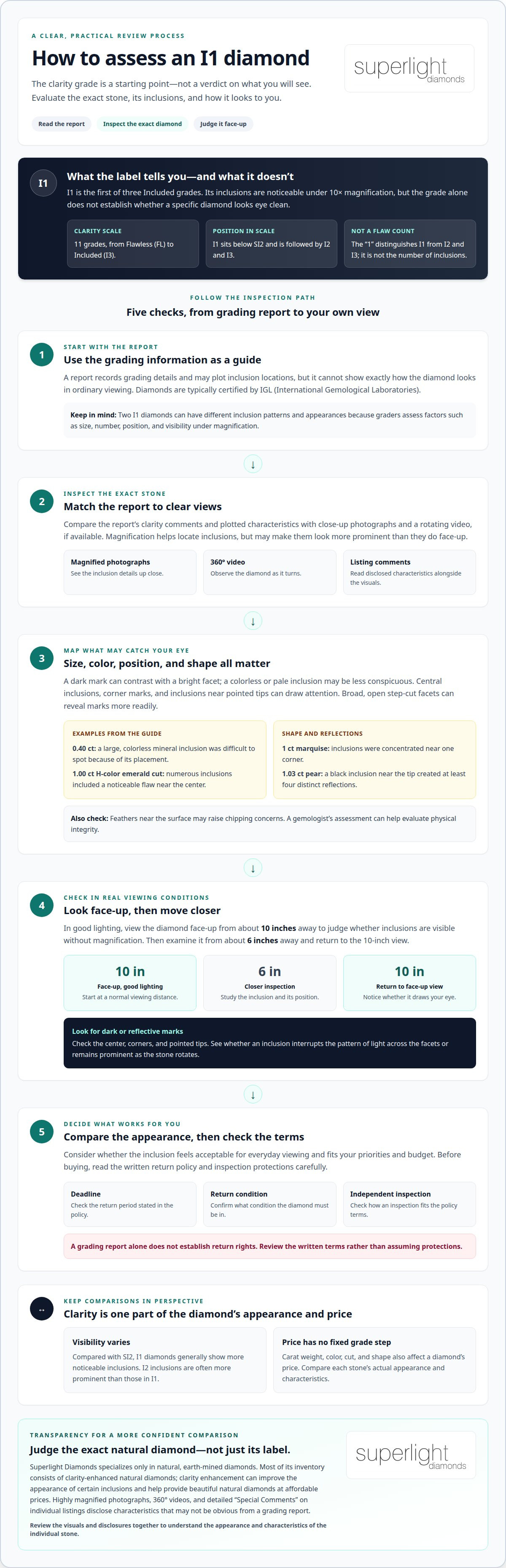
An inclusion’s position can make it more or less noticeable in an I1 diamond. A 0.40-carat I1 example has a large, colorless mineral inclusion that is difficult to spot because of its placement. By contrast, a 1.00-carat H-color emerald cut shows numerous inclusions, including a noticeable flaw near the center. A central mark can draw the eye, while a pale inclusion near an edge may blend into the diamond’s facets.
Shape also affects where inclusions catch attention. A 1-carat marquise example has inclusions concentrated near one corner, while a 1.03-carat pear example has a black inclusion near its tip. That dark mark creates at least four distinct reflections. Long, pointed shapes can make inclusions near their tips or corners especially apparent; step-cut emerald shapes can reveal marks through their broad, open facets.
Compared with SI2, I1 diamonds generally show more noticeable inclusions; I2 inclusions are often more prominent than those in I1. Price has no fixed step between these grades: carat weight, color, cut, and shape also affect a diamond’s price.
Judge eye cleanliness face-up in good lighting, with the diamond about ten inches from your eyes. This distance helps reveal whether inclusions are visible without magnification. For a closer practical check, examine the stone from about six inches away, then return to the ten-inch view. Look for dark or reflective marks near the center, corners, and pointed tips.
Eye cleanliness depends on more than the number of inclusions. A dark mark may contrast sharply with a bright facet, while a colorless inclusion can be harder to spot. View the diamond face-up and check whether inclusions interrupt the pattern of light across its facets.
2. Tips for choosing an I1 diamond
Start with the grading report, then assess the individual stone’s appearance. Diamonds are typically certified by IGL (International Gemological Laboratories). A report records grading information, but it cannot show exactly how a diamond looks in ordinary viewing. Compare its clarity comments with close-up images and a rotating video, if available. Magnification can help locate inclusions, but it can also make them appear more prominent than they do face-up.
Next, consider the inclusion’s position and type. Dark crystals can stand out against bright facets, while pale inclusions may be less conspicuous. Pay particular attention to feathers near the surface, as their position may raise concerns about chipping. A gemologist’s assessment can help evaluate the stone’s physical integrity. Also consider whether an inclusion disrupts the diamond’s appearance or catches your eye as it rotates.
Judge the diamond at a normal viewing distance, then move closer to study the inclusion. An I1 stone that looks acceptable from across a room may reveal distracting marks during close inspection. Compare the face-up view with magnified images, and assess whether the inclusion remains prominent as the stone turns. Decide which visible characteristics you’re comfortable seeing regularly.
Before buying, read the written return policy and inspection protections. Check its deadline, the condition required for a return, and how an independent inspection fits the terms. Don’t assume a grading report alone provides return rights. For a practical comparison, review natural diamond options alongside each stone’s available images and disclosures.
3. Meaning of I1 diamond clarity
The GIA clarity grading system has 11 grades, from Flawless (FL) to Included (I3). I1 is the first of three Included grades, followed by I2 and I3. It sits below SI2, the lowest grade in the Slightly Included category.
The I in I1 means “Included,” referring to internal inclusions or external blemishes. The number separates I1 from I2 and I3; it isn’t a count of flaws. Graders assess characteristics such as their size, number, position, and visibility under magnification. Two diamonds with I1 grades can therefore have different inclusion patterns and appearances.
An I1 grade indicates that inclusions are noticeable under 10X magnification. They may also be visible to the unaided eye, but the grade alone doesn’t establish how noticeable a specific diamond looks. The type and placement of inclusions, along with the diamond’s shape, influence their appearance.
Do diamond grading reports state whether an I1 diamond is eye clean? A grading report identifies the clarity grade and may show inclusion locations on a plot, but it doesn’t establish that the diamond appears eye clean. Eye cleanliness describes what someone can see without magnification, so assess the actual stone’s appearance as well as its report.
Use the I1 label as a starting point, not a complete description. Compare the report’s plotted characteristics with clear views of the exact diamond, including magnified images and a rotating video. Review individual diamond details to see the characteristics disclosed for each stone.
Superlight Diamonds: Clarity Enhanced Diamonds
Superlight Diamonds specializes only in natural, earth-mined diamonds, and most of its inventory consists of clarity-enhanced natural diamonds. Clarity enhancement can improve the appearance of certain inclusions, helping provide beautiful natural diamonds at affordable prices.
For an I1 diamond, judge the exact stone rather than relying on its grade alone. Superlight Diamonds provides highly magnified photographs, 360° videos, and detailed “Special Comments” on individual listings to disclose characteristics that may not be obvious from a grading report. Review those details together to understand what the diamond looks like and what has been disclosed.
Whether you’re considering a clarity-enhanced stone or another natural diamond, focus on the appearance, cut, and characteristics that matter most to you. Contact Superlight Diamonds to discuss your diamond choices.
Choose the diamond that feels right to you
Whether an I1 clarity diamond is ever eye clean matters less than whether a particular stone’s appearance suits your preferences for everyday wear. Set your priorities before choosing: a cleaner-looking face-up view, a larger-looking diamond within your budget, or a balance of both. Let the individual stone guide your decision rather than treating its grade as a complete verdict.
Superlight Diamonds specializes only in natural earth-mined diamonds, including Round Brilliant Diamonds, Princess Cut Diamonds, and Clarity Enhanced Diamonds. Clarity enhancement offers another way to consider natural diamond beauty and value. Focus on the visible characteristics you’re comfortable wearing, not on pressure to meet an arbitrary clarity grade.
Ready to consider your options? Contact Superlight Diamonds to take the next step. A thoughtful choice starts with your priorities, and you can move forward at your own pace.
Frequently Asked Questions
What Does an I1 Clarity Mean?
I1 is the first grade in the Included clarity category. For a buyer, the label signals that clarity deserves attention, but it doesn’t describe every aspect of the diamond. Consider clarity alongside color, cut, and carat weight, then decide which visible features matter most to you. A clarity grade alone can’t establish whether the stone suits your preferences.
Can an I1 clarity diamond be eye clean?
Yes, an I1 clarity diamond can appear eye clean to some viewers. The useful next step is deciding what “clean” means for your own purchase: no visible marks during everyday wear, or no distracting feature during close inspection. That preference helps you evaluate a specific stone without assuming that every I1 will look alike.
What does I1 clarity mean on the GIA diamond clarity scale?
On the GIA scale, I1 is the first grade in the Included category, which also contains I2 and I3. The label places the diamond within the scale; it doesn’t describe its overall appearance, cut performance, or suitability for a particular piece of jewelry. Use it as one specification among the details considered when comparing stones.
How often are I1 diamonds eye clean at normal viewing distance?
There isn’t a useful universal frequency for how often I1 diamonds appear eye clean. A percentage would depend on which stones were assessed, the viewing conditions, and how observers define “eye clean.” For an individual purchase, a broad frequency estimate is less useful than judging whether the specific diamond meets your own expectations.
How do diamond cut, shape, and carat weight affect whether an I1 looks eye clean?
Carat measures weight, not face-up diameter, so two diamonds with the same carat weight can show inclusions differently. Cut and shape affect how facets reflect light around an inclusion, changing its contrast. When comparing stones, assess their actual face-up appearance rather than relying on carat weight alone, and consider how your planned setting will frame the diamond.