Loading... Please wait...
 USD



Recent Posts
Eye clean SI1 diamond selection and clarity grades
Posted on

A lower clarity grade doesn’t automatically mean a diamond looks cloudy. An eye-clean diamond has no inclusions visible to the naked eye under regular viewing conditions, and some SI1 diamonds meet that standard. This eye clean SI1 diamond selection guide explains why the grade alone can’t tell you what you’ll see face-up.
It’s reasonable to want visible beauty without paying for microscopic details you won’t notice in everyday wear. But SI1 spans a range: inclusion size, color, position, and the diamond’s cut all affect whether marks catch your eye. You’ll learn what eye clean means, which clarity grades are more likely to look clean, and how to assess an individual SI1 natural earth-mined diamond using its actual images and video rather than relying on a grading report alone. The goal is a confident, value-conscious choice based on the stone’s appearance.
Key Takeaways
- Clarity grades are based on inclusions and blemishes examined under magnification, but the grade alone doesn’t show how visible they’ll be in everyday viewing.
- Eye clean means inclusions aren’t visible to the naked eye under normal viewing conditions; dark marks can stand out more than subtle features.
- SI1 diamonds vary in appearance, so assess each stone’s inclusion position and how it looks face-up rather than choosing by grade alone.
- Use detailed images and video of the exact diamond to judge its visible appearance, not just its grading report.
Which clarity grades are eye clean?
Clarity describes a diamond’s inclusions and blemishes, assessed under magnification. In the GIA system, graders use 10x magnification across 11 grades in six categories, from Flawless to Included. Diamonds are typically certified by IGL (International Gemological Laboratories), so review the grading report alongside images and video of the exact diamond.
Grades Versus Visible Appearance
A clarity grade describes characteristics seen under magnification, not exactly how visible they appear during everyday viewing. Two SI1 stones can differ because inclusions vary in size, color, position, and how they interact with light. For jewelry shopping, the face-up appearance matters: a small mark near the edge may draw less attention than a dark inclusion near the center.
Shape and SI1 Clarity Appearance
Shape and carat weight affect how easily inclusions catch the eye. Emerald-cut and Asscher-cut diamonds have broad, open facets that can make marks easier to notice, so buyers often consider VS1 or VS2 for these shapes. In stones of 2 or more carats, inclusions may also be more visible. Cut quality affects sparkle, but it doesn’t erase an inclusion; judge the exact diamond face-up.
Comparing SI1 and VS2 Diamonds
VS2 diamonds generally have fewer or less noticeable inclusions than SI1 diamonds, but neither grade guarantees an eye-clean appearance. Some carefully selected SI1 stones look clean face-up, while an inclusion’s position or dark color can make another SI1 more visible. Comparable VS2 diamonds are often priced higher, so compare the actual appearance before deciding whether the clarity difference is worth the added cost.
Purchase Checks for SI1 Diamonds
Before buying, review the written return policy and any inspection period, including the deadline and conditions for returns. Check the grading report’s grade and inclusion details against the exact stone, but don’t rely on the report alone to judge its appearance. A report describes grading characteristics, but detailed images and video help show how an SI1 diamond looks face-up. These checks clarify both what you’re buying and what options apply after delivery.
What Does “Eye Clean” Mean in Diamonds?
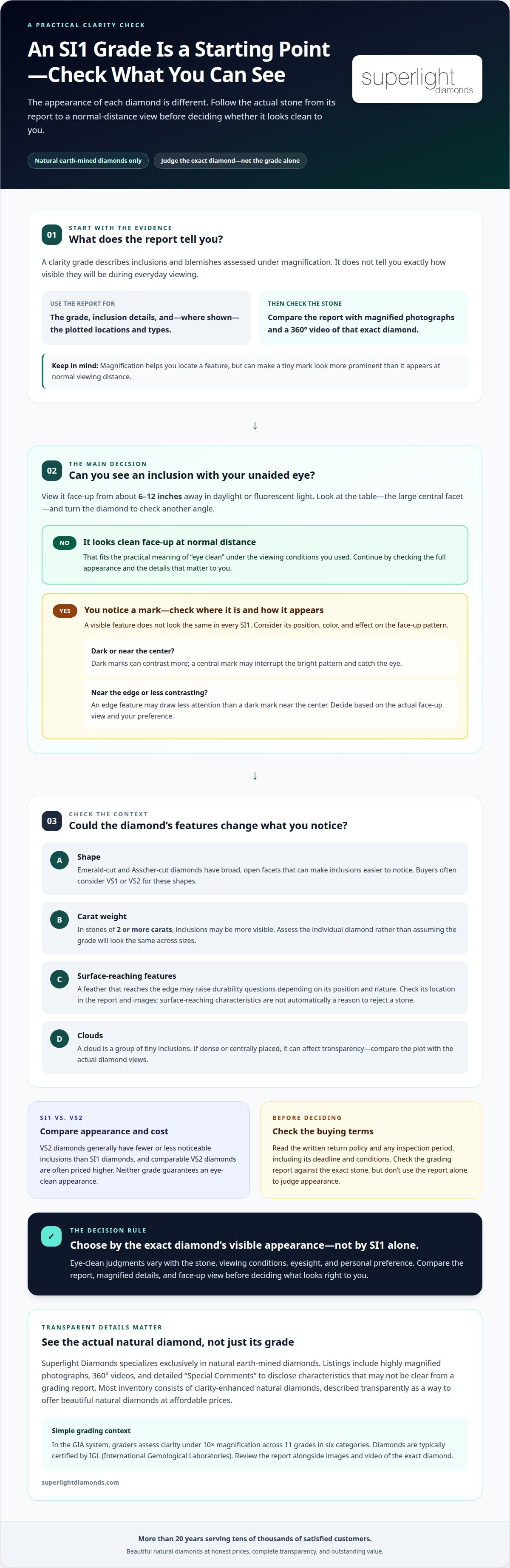
Eye clean means no inclusions are visible to the unaided eye under regular viewing conditions. A practical check views the diamond face-up from 6 to 12 inches in daylight or fluorescent light.
Visible Inclusions and Sparkle
Dark inclusions can be easier to see than pale or transparent characteristics because they contrast with the diamond. A dark mark near the center may catch the eye and interrupt the stone’s face-up pattern, while a similar mark near the edge may be less noticeable. For an engagement ring, an inclusion’s position can matter as much as its size.
Surface-Reaching Inclusions
A surface-reaching inclusion extends from inside the diamond to its surface, unlike a characteristic located entirely within it. A feather reaching the edge may raise durability questions depending on its position and nature, so review its location in the grading report and images. Surface-reaching characteristics aren’t automatically a reason to reject a stone, but they deserve attention when you’re buying.
Checking for Visible Inclusions
View the diamond face-up in good lighting from at least 6 inches away, then turn it to see whether a mark becomes obvious from another angle. Look closely at the table, the large central facet, where inclusions can be especially visible. Highly magnified images help locate characteristics, but magnification can make tiny marks look more prominent than they appear at normal viewing distance.
Inclusion Variation and Personal Preference
SI1 covers a range: one stone may have characteristics closer to SI2, while another may approach VS2 in appearance. Eye-clean judgments also depend on vision and personal preference. One buyer may notice a small mark immediately; another may find it almost invisible. Focus on whether the actual diamond looks clean to you face-up, rather than expecting every stone in the same grade to look alike.
SI1 diamonds and eye-clean selection
Use this eye clean SI1 diamond selection guide as a way to assess the individual stone, not as a reason to accept or reject every diamond with an SI1 grade. Start with the grading report’s clarity plot, which maps the type and position of characteristics. For diamonds of at least 1 carat, reports may show inclusion locations and types. A cloud is a group of tiny inclusions; if dense or centrally placed, it can affect transparency.
Next, compare the plot with magnified photographs and a 360° video of the exact diamond. Magnification helps locate a feather, crystal, or cloud, but can make small features look prominent. Return to the face-up view at normal distance. Notice whether a mark is obvious, interrupts the bright pattern, or blends into the stone’s appearance.
For an engagement ring, consider how the diamond will look during everyday wear, not just in a magnified image. A mark near the edge may be less noticeable than one beneath the table, while a dark inclusion can stand out against bright facets. The right choice depends on the individual diamond and the visual details that matter to you.
A practical eye clean SI1 diamond selection guide pairs the report with views of the actual stone, including any detailed comments about its characteristics. That approach also helps buyers understand clarity-enhanced natural diamonds through clear descriptions of each diamond. Review the exact stone’s diamond photos and 360° videos alongside its report, then choose based on its visible appearance and your priorities.
Superlight Diamonds
Superlight Diamonds specializes exclusively in natural earth-mined diamonds, with one of the largest online selections of natural loose diamonds and competitive prices. Clear information helps you assess an SI1 stone beyond its grade. Listings include highly magnified photographs, 360° videos, and detailed “Special Comments” that disclose characteristics a grading report may not show clearly. Reviewing the exact diamond’s visuals can help you judge inclusion visibility and make a choice that fits your priorities.
Most of the selection consists of clarity-enhanced natural diamonds, a process used to offer beautiful stones at affordable prices. Each diamond’s details matter, so consider its images and disclosures alongside its report when comparing clarity and appearance. Superlight Diamonds has served over 21,000 clients since its founding in 2001.
For help understanding the details of a particular SI1 diamond, contact Superlight Diamonds.
Choose a Diamond That Fits Your Priorities
Before choosing, decide which compromise would feel right to you after the excitement of buying has passed. Set a spending limit, rank your preferences, and use this eye clean SI1 diamond selection guide to keep those priorities clear. For example, you might value the overall look most, or prefer to stay within budget even if that means accepting a small visible characteristic. A clear personal benchmark can make the final decision feel considered rather than rushed.
If you’re weighing a particular diamond against your priorities, Contact Superlight Diamonds for guidance. Bring your questions about what matters most to you, and make the decision at your own pace. The right choice is the one that feels beautiful and sensible for your needs.
Frequently Asked Questions
What is an SI1 Clarity Diamond?
SI1 is a grade within the Slightly Included clarity category, distinguished from SI2 by its position in that category. It doesn’t describe one fixed inclusion pattern: a stone might contain a crystal, feather, or several small features. For a practical comparison, consider the type and arrangement of inclusions rather than treating every SI1 diamond as visually identical.
What does eye-clean mean for an SI1 diamond?
“Eye clean” is a descriptive term, not a separate clarity grade on a diamond report. Two people can assess the same SI1 stone differently because eyesight and attention vary. Before choosing, decide whether you’re comfortable with a feature you can locate after careful inspection, even if it doesn’t draw your attention during a quick glance.
Which diamond shapes hide SI1 inclusions best?
No shape reliably hides every inclusion. The setting can also affect what catches the eye: halo and side-stone designs may draw attention across the jewelry, while a solitaire leaves the center diamond on its own. Choose a shape you like, then consider how the inclusion pattern and setting work together rather than expecting the outline alone to conceal a mark.
How can you check whether an SI1 diamond is eye-clean before buying online?
Make sure the listing’s photographs and video show the same individual diamond described in its report. Read the seller’s comments for characteristics that may not be clear from the grading summary, including clarity enhancement where applicable. Then assess the stone at a normal display size, not only in a tightly cropped enlargement, which can make small details dominate the screen.
What magnification and viewing distance do jewelers use to assess eye-clean diamonds?
Jewellers use magnification to grade clarity, but eye-clean appearance is judged without magnification at an ordinary viewing distance. There is no single viewing distance used by every jeweller. The key distinction is between locating a characteristic with a loupe and deciding whether it stands out when viewing the diamond naturally, face-up.