Loading... Please wait...
 USD



Recent Posts
Elongated Cushion Cut Price and What Shapes the Cost
Posted on
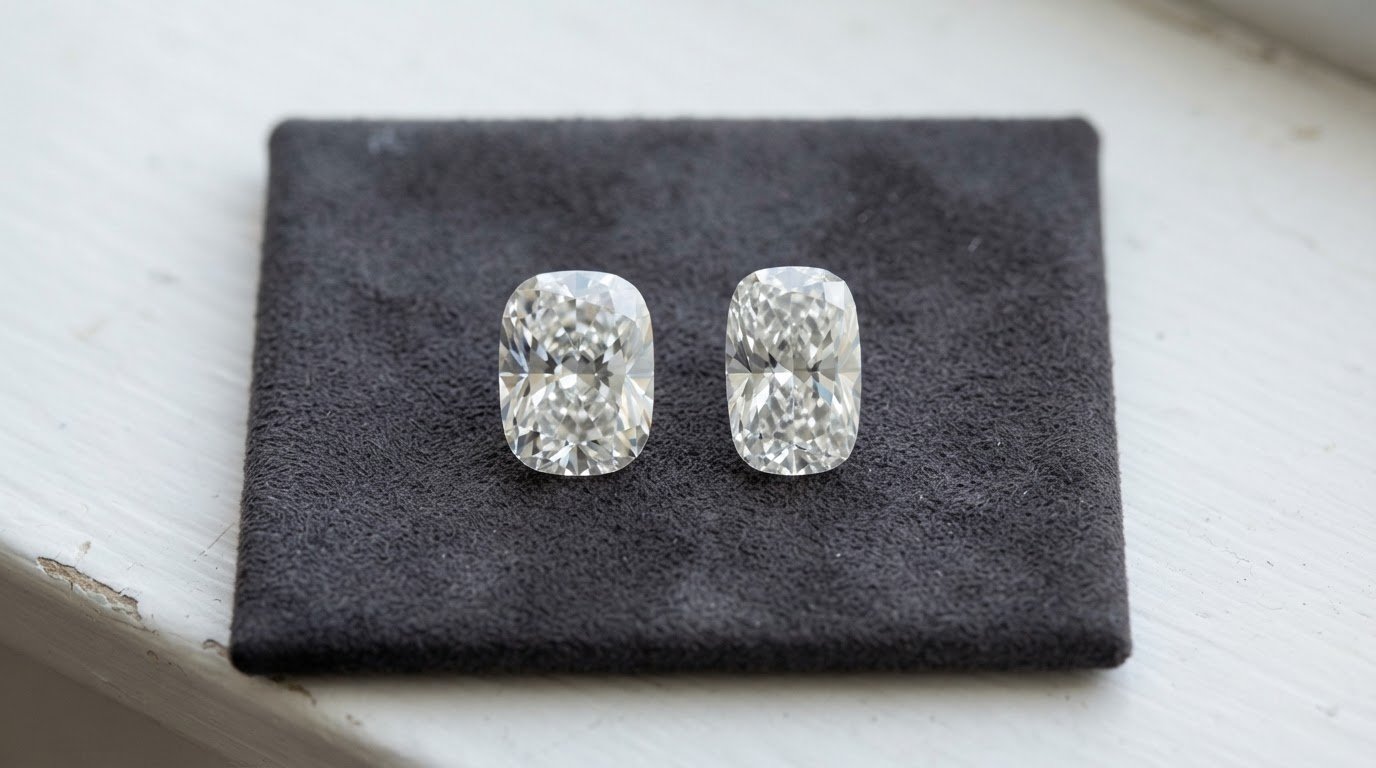
The longer-looking cushion isn’t automatically the more expensive one. In an elongated cushion cut ratio of 1.15 versus 1.20, the difference is mainly visual: 1.15 looks softly elongated, while 1.20 has a more noticeable rectangular outline. The ratio alone doesn’t determine a diamond’s price; carat weight, cut quality, clarity, and color matter more.
It’s understandable to focus on shape when you want a cushion that looks balanced on the hand and offers the proportions you prefer. This article explains how ratios affect a stone’s appearance, what can influence its cost, and why evaluating sparkle and the individual diamond matters alongside its grading details. You’ll come away with a clearer way to compare similar-looking cushions without assuming that a slightly longer shape must carry a higher price.
Key Takeaways
- Calculate a cushion’s proportions by comparing its length with its width, then decide whether its outline suits your preferred look.
- Look beyond the face-up shape: depth and table proportions can affect how large a diamond appears and how its light returns.
- Fancy-shaped diamonds don’t receive an overall cut grade from GIA, so examine the stone’s visual performance as well as its grading details.
- Color and clarity are personal value choices; compare the diamond itself to judge which characteristics matter most to you.
Length-to-width ratio: how long is long?
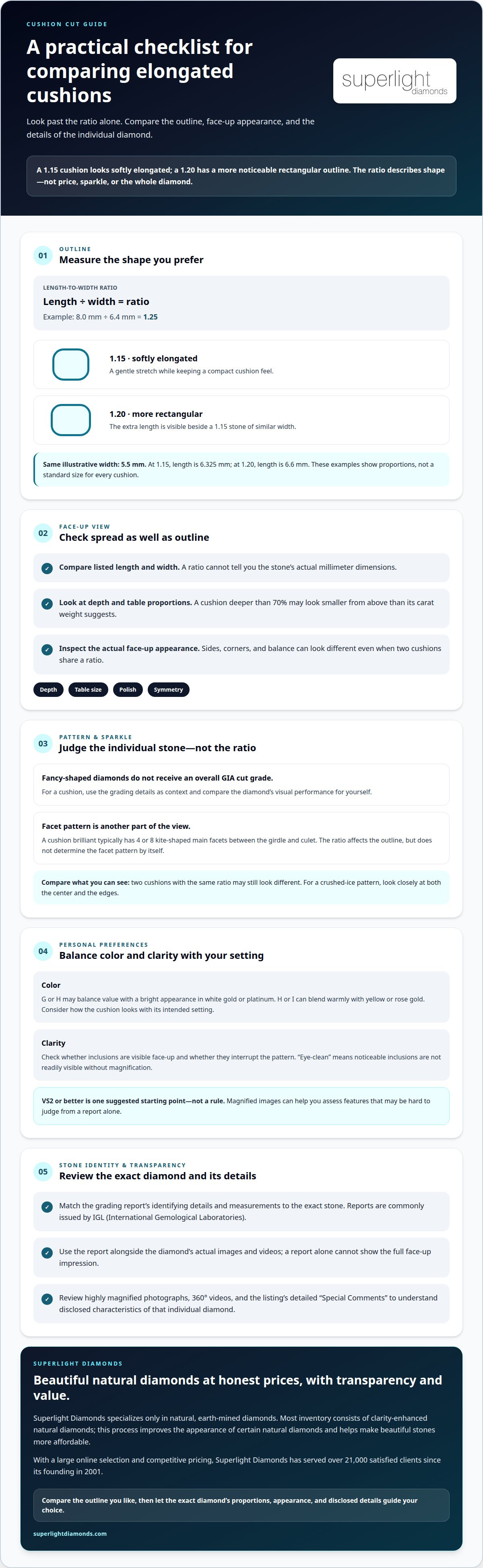
A cushion’s ratio compares its length with its width, shaping whether it looks compact or rectangular. A shift from 1.15 to 1.20 creates a visible, though modest, change in outline.
Calculating Cushion Length-to-Width Ratios
Divide a cushion diamond’s length by its width to calculate its length-to-width ratio. For example, a stone measuring 8.0 mm long and 6.4 mm wide has a ratio of 1.25. This simple calculation helps compare stones with different measurements and carat weights. Use the ratio as a guide to proportions, not as a complete description of the diamond’s appearance.
Ratio Effects on Elongated Appearance
A 1.15 ratio usually looks softly elongated, while 1.20 gives the cushion a more distinctly rectangular direction. Both retain the rounded corners associated with cushion cuts, but the extra length at 1.20 is visible beside a 1.15 stone of similar width. If you prefer a compact outline with a gentle stretch, 1.15 may suit you; choose 1.20 for a longer look on the finger.
Cushion Dimensions at Each Ratio
A ratio alone can’t establish typical millimeter dimensions because actual length and width depend on the stone’s size and cut. For a direct comparison at the same illustrative width of 5.5 mm, a 1.15 ratio gives a length of 6.325 mm, while a 1.20 ratio gives 6.6 mm. A cushion measuring 6.6 mm by 5.5 mm therefore has a 1.20 ratio. These examples show how the ratio changes proportions, not a standard size for every cushion.
Facet Patterns and Face-Up Appearance
Ratio changes the face-up outline, but it doesn’t determine the facet pattern by itself. A cushion brilliant typically has 4 or 8 kite-shaped main facets between the girdle and culet. At 1.15, that pattern sits within a squatter outline; at 1.20, the longer shape can make its length more apparent. Compare the actual visible pattern as well as proportions, since two stones with the same ratio may look different.
Cut quality, color, clarity, and stone identity
A cushion’s ratio describes its outline, not its sparkle or overall cut quality. GIA doesn’t issue an overall cut grade for fancy-shaped diamonds, including cushion cuts, so a grade alone can’t settle how a stone performs. Compare its face-up appearance and proportions. Depth, table size, polish, and symmetry add useful context: a cushion deeper than 70% may look smaller from above than its carat weight suggests.
Color and clarity are personal preferences, not automatic measures of beauty. A G or H color may balance value with a bright appearance in white gold or platinum, while H or I can blend warmly with yellow or rose gold. Cushion facets can show color differently from round brilliant facets, so consider how the diamond looks with its intended setting. A solitaire leaves more of the stone visible, while surrounding details can change the overall impression.
For clarity, focus on whether inclusions are visible face-up and whether they interrupt the pattern. “Eye-clean” means noticeable inclusions aren’t readily visible without magnification; it doesn’t name a formal clarity grade. A VS2 grade or better is one suggested starting point, not a rule every buyer must follow. Magnified images help reveal features that may be difficult to judge from a report alone.
A grading report describes a specific diamond, including its measurements and clarity characteristics. Reports are commonly issued by IGL (International Gemological Laboratories), and the report should match the exact stone. Compare its identifying details with the diamond listing and images. For a cushion with a crushed-ice pattern, inspect the center and edges closely, since the pattern, color, and visible inclusions all affect its appearance.
Classic elongated cushion ratio range
A cushion’s ratio is a visual reference, not a formal grading category. At 1.00, the outline is square; above 1.30, it can read as a true rectangle. These labels describe the general shape, not whether the corners are broadly rounded or the sides appear balanced. Use the number as one clue when comparing outlines, rather than a complete description of the stone.
Past 1.40, a cushion can look dramatically elongated and begin to resemble a radiant with rounded corners. That shift matters if you want the recognizable cushion outline, rather than a long rectangular shape. The corner profile and the stone’s length and width work together, so two stones with similar ratios may still have distinct silhouettes.
Assess the outline from above, looking for even sides and corners that suit your preferred shape. A deeper cushion may show less surface spread than its weight suggests, so consider its dimensions alongside the ratio. This helps distinguish an elongated outline from a stone that carries more weight below the surface.
Think of the classic range as a starting point, then decide how much rectangular character suits your setting and taste. A square outline preserves a compact cushion look; a more extended outline changes the overall balance. Compare the listed measurements with the actual face-up view as you compare cushion diamond proportions and choose a shape that feels right to you.
Superlight Diamonds: Round Brilliant Diamonds
Superlight Diamonds specializes only in natural, earth-mined diamonds, including Cushion Cut Diamonds and Round Brilliant Diamonds. Its large online selection and competitive pricing help buyers compare options with value in mind. Since its founding in 2001, the company has served over 21,000 satisfied clients.
Most inventory consists of clarity-enhanced natural diamonds. This process improves the appearance of certain natural diamonds and helps make beautiful stones more affordable. Listings include highly magnified photographs, 360° videos, and detailed “Special Comments,” so you can assess the exact diamond’s characteristics alongside its grading report.
Explore the cushion diamond listings at Superlight Diamonds to compare individual natural stones and their disclosed features. You can also use the Diamond Finder to narrow your options and review Diamond Education resources as you decide.
Choose the diamond that fits your priorities
Decide which qualities matter most in the diamond you’ll wear: its outline, its face-up appearance, or how it fits your budget. Comparing an elongated cushion cut ratio of 1.15 versus 1.20 can clarify your shape preference, but let the individual stone guide your final choice.
If you’re considering other shapes, Superlight Diamonds also offers Round Brilliant, Princess Cut, and Clarity Enhanced Diamonds. Comparing these natural-diamond options can help you focus on the appearance and characteristics that suit your priorities, rather than paying for details you may not value.
For a considered next step, contact Superlight Diamonds for guidance as you compare your options. Take your time, trust what you can see in the exact diamond, and choose the one that feels right for you.
Frequently Asked Questions
Are elongated cushions more expensive?
Not simply because they’re elongated. Compare diamonds with similar characteristics, since carat weight can affect pricing independently of outline. Comparing stones with similar characteristics can help you explore different value options, since carat weight can affect pricing independently of outline. The best comparison considers the exact stone, not its ratio alone.
Ideal Cushion Cut Diamond Ratios: What’s Preferred?
There’s no single ideal proportion for every buyer. Consider how the diamond’s outline will look in your chosen setting and whether you want the stone to be the design’s main visual feature. A simple solitaire keeps attention on the cushion’s outline, while a more detailed setting adds other visual elements. Choose the proportion that suits the overall design you have in mind.
Is a 1.15 ratio considered elongated?
Usually, yes, but the word “elongated” isn’t applied identically by every seller. Some may use it for a cushion with a 1.12 ratio, while others reserve the label for higher ratios. Treat the description as a general shape cue and use the stone’s measurements and face-up outline to understand what the label means for that particular diamond.
What does length-to-width ratio mean for an elongated cushion cut diamond?
The ratio compares a diamond’s length with its width and describes its outline, not its carat weight, depth, or clarity. Two cushion cuts can share a ratio yet differ in these other characteristics. For a fuller picture, read the measurements alongside the grading details and examine the individual stone’s appearance.
How does a 1.15 ratio compare visually with a 1.20 ratio cushion cut?
The difference is easiest to see when comparing stones under the same viewing conditions. Listing images shown at different sizes can make one cushion seem longer than another, so use the stated measurements to put what you see in context. Also consider whether the stone’s corners and overall outline suit the style of ring setting you have in mind.