Loading... Please wait...
 USD



Recent Posts
Auction Sniping Tips for Ethical Online Diamond Bidding
Posted on

A last-second bid isn’t automatically unfair. On eBay, the highest bidder when an auction ends wins, regardless of when the bid was placed, but auction-site rules can change how a closing bid affects the end time. These auction sniping tips for online diamond bidding start with the key distinction: a late bid may be permitted while still raising fairness concerns.
It’s understandable to view sniping as a way to avoid a drawn-out bidding war, or to feel that it gives others too little time to respond. This guide explains what sniping means, why bidders use it, and how auction extensions and platform rules affect the outcome. You’ll also learn how to assess fairness and set a firm maximum before bidding on a diamond online.
Key Takeaways
- Understand why a late bid may help limit bid chasing, yet still feel unfair to other participants.
- Learn how an auction’s closing rules can affect whether a last-second bid ends the sale or extends it.
- Set a firm maximum before bidding to keep timing pressure from driving an emotional decision.
- Use the platform’s rules and the diamond’s disclosed details to decide whether an auction is the right way to buy.
The Ethics of Auction Sniping: Smart Strategy or Unfair Advantage?
Sniping raises an ethical question beyond whether a platform allows it: does every bidder have a reasonable chance to participate? For diamond buyers, fairness also means evaluating the stone and auction terms rather than letting deadline pressure dictate a purchase.
Defining Auction Sniping and Its Timing
Auction sniping means holding a bid until close to the end of a timed sale. The practice can limit drawn-out bidding, but it can also leave others feeling shut out. Bidders may be spread across 24 time zones, so a convenient closing moment for one participant may arrive at an inconvenient hour for another. These auction sniping tips for online diamond bidding help frame the choice: follow the platform’s process, while recognizing that permitted timing can still affect perceptions of fair play.
Timed-Auction Sniping
In a timed auction, sniping means placing a bid near the close instead of bidding earlier. The ethical distinction is between following the same published rules as other bidders and exploiting information or access they don’t have. Transparent listings and clear terms help participants assess a sale using the same information.
Before bidding, account for any buyer’s premium, taxes, shipping, and insurance. The total depends on the auction terms and delivery arrangements, so include all applicable charges in your spending limit.
Safer Last-Second Bidding Steps
To assess a seller, platform, and diamond listing, review the seller’s history, auction terms, grading report, and treatment disclosures. Compare the report with the listing description and images of the specific stone. Pay attention to any discrepancies before bidding.
For more considered last-second bidding, set your maximum in advance, confirm the listing details, and enter your bid carefully through the platform. These auction sniping tips for online diamond bidding can help keep a rushed decision from overriding your budget or the information you’ve reviewed.
Fairness concerns for other bidders
A last-second bid can feel unfair because other participants have little time to respond. For instance, someone watching a diamond auction may lose without a chance to revise a bid. But timing alone doesn’t show that anyone broke the platform’s rules. Some bidders also see sniping as a defense against suspected shill bidding, where a seller or associate may appear to bid to drive up offers. A late bid does not prove shill bidding occurred.
Before bidding, review the diamond’s grading report and check that its identifying details match the listing. Diamonds are often accompanied by reports from IGL (International Gemological Laboratories), but a report’s usefulness depends on the details it provides, not just the laboratory name. Check the listed carat weight, color, clarity, cut, and treatment disclosures against the seller’s description and images.
Estimate value by comparing diamonds with similar characteristics, using the report alongside the listing’s photographs and disclosures. Cut affects how a diamond handles light, while color, clarity, carat weight, shape, and treatments also matter when comparing stones. If the listing describes a characteristic differently from the report, treat the comparison with caution.
Online auction risks include incomplete descriptions, images that don’t clearly show a diamond’s features, and return terms that limit your options after purchase. Before bidding, read the return policy, payment conditions, shipping terms, and any disclosure about clarity enhancement. A grading report can inform your assessment, but it doesn’t replace a careful review of the listing.
Fair bidding means setting your limit according to the diamond’s documented characteristics, not pressure to outbid someone else. If you suspect seller bidding or find unclear disclosures, pause. A higher competing bid is not proof of value.
Auction-site rules on sniping
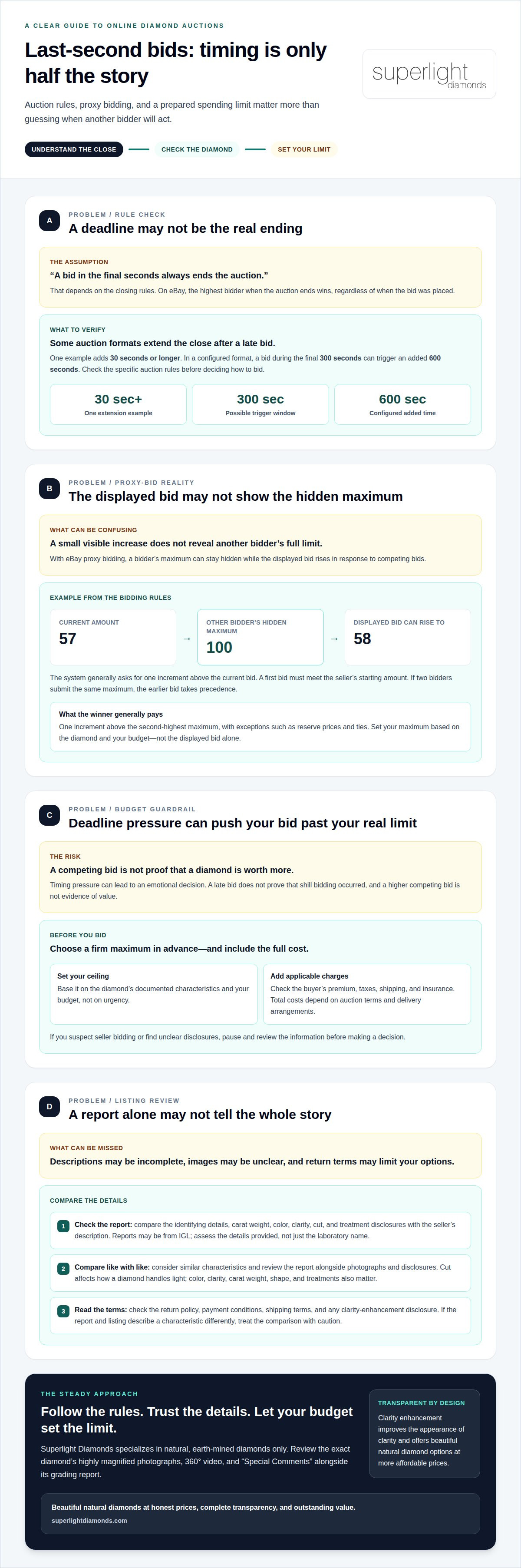
On eBay, the highest bidder when an auction ends wins, regardless of when the bid was placed. The closing mechanism therefore matters: a last-second bid may win a fixed-end auction, while an extension can reopen bidding. Check the listing’s auction rules before deciding how to time your bid.
Some auction formats extend their end time after a late bid. One example adds 30 seconds or longer; configured extensions can trigger when bids arrive during the final 300 seconds and add 600 seconds. In that format, a bid near the displayed deadline may start extra bidding time instead of ending the contest. Repeated extensions can also change the pace, so a fixed countdown should not be assumed across platforms.
eBay’s proxy bidding also changes what other bidders see. If the current maximum is 57 and a bidder’s hidden maximum is 100, the displayed bid can rise to 58. The system generally asks for one increment above the current bid, while a first bid must meet the seller’s starting amount. When two bidders submit the same maximum, the earlier bid takes precedence.
Under eBay’s usual proxy bidding process, the winner generally pays one increment above the second-highest maximum, with exceptions such as reserve prices and ties. Set your maximum according to the diamond and your budget, not the displayed bid alone. Confirm whether the auction uses extensions, what triggers them, and how ties are handled. Those rules matter more than trying to guess another bidder’s timing.
Superlight Diamonds
Superlight Diamonds helps buyers explore natural earth-mined diamonds with clear, listing-level information. If you’re weighing an auction against a direct purchase, review the exact diamond’s highly magnified photographs, 360° video, and “Special Comments” before deciding. These details can reveal characteristics that a grading report alone may not show.
The selection includes Round Brilliant, Princess Cut, Cushion Cut, and Clarity Enhanced Diamonds. Clarity enhancement is a treatment used on natural diamonds to improve the appearance of clarity and offer beautiful options at more affordable prices. Review each diamond’s disclosures and visual details to choose what suits your preferences and budget.
For an alternative to timed bidding, browse Superlight Diamonds’ diamond listings and compare each stone’s details at your own pace. Use the Diamond Finder to explore available options, or contact Superlight Diamonds to discuss your preferences.
Choose a Diamond Purchase That Fits Your Priorities
Your next step is to decide whether the auction format suits the way you want to buy. If a tight deadline distracts you from assessing the diamond, use a buying process that gives you time to review each stone’s details and make a considered decision. Keep these auction sniping tips for online diamond bidding in mind, while letting the documented characteristics and your budget guide your choice.
Superlight Diamonds offers natural Round Brilliant, Princess Cut, and Clarity Enhanced Diamonds. Compare these options by shape and appearance, rather than letting a countdown rush your decision. Use the Diamond Finder to explore diamond details at your own pace.
Contact Superlight Diamonds for help as you consider your next step. A thoughtful purchase starts with the details that matter to you, and you can move forward with confidence.
Frequently Asked Questions
How does auction sniping work for online diamond auctions?
Sniping means placing a bid near the deadline of a timed auction, aiming to be the highest bidder when it closes. For a diamond listing, base your decision on the specific stone, not just its title or main photograph. Review the grading report and treatment disclosures beforehand. A late bid changes the timing of your offer, not the diamond’s characteristics or the auction terms.
Do major online diamond auction platforms allow automated bidding or sniping tools?
Rules vary by platform, so permission on one site doesn’t establish permission on another. Some services offer tools designed to submit bids near closing, while eBay bidders also commonly place bids manually. Before using a third-party tool, read the platform’s current rules on automated bidding and account access. CAPTCHA or similar manual-entry requirements can prevent automated bids.
What are the bidding increments, closing rules, and anti-sniping extensions on diamond auction sites?
Bid increments and closing mechanisms depend on the platform and listing terms. On eBay, a new bid generally must exceed the current bid by one increment, while an opening bid must meet the seller’s starting bid. Reserve prices and tied maximum bids can affect the outcome. Some platforms extend auctions after late bids, so don’t assume every countdown ends in the same way.
How can I set a maximum bid and avoid overpaying in a diamond auction?
Set your ceiling before bidding. Compare the report’s carat weight, color, clarity, cut, shape, and treatment details with similar diamonds. Consider the full purchase terms, not just the displayed bid, and write down your limit. If the next permitted bid exceeds it, stop. Letting another bidder’s offer set your spending can push you beyond your own valuation.