Loading... Please wait...
 USD



Blog
Recent Posts
Round Brilliant Diamond Cut Proportions and How They Affect Sparkle
Posted on
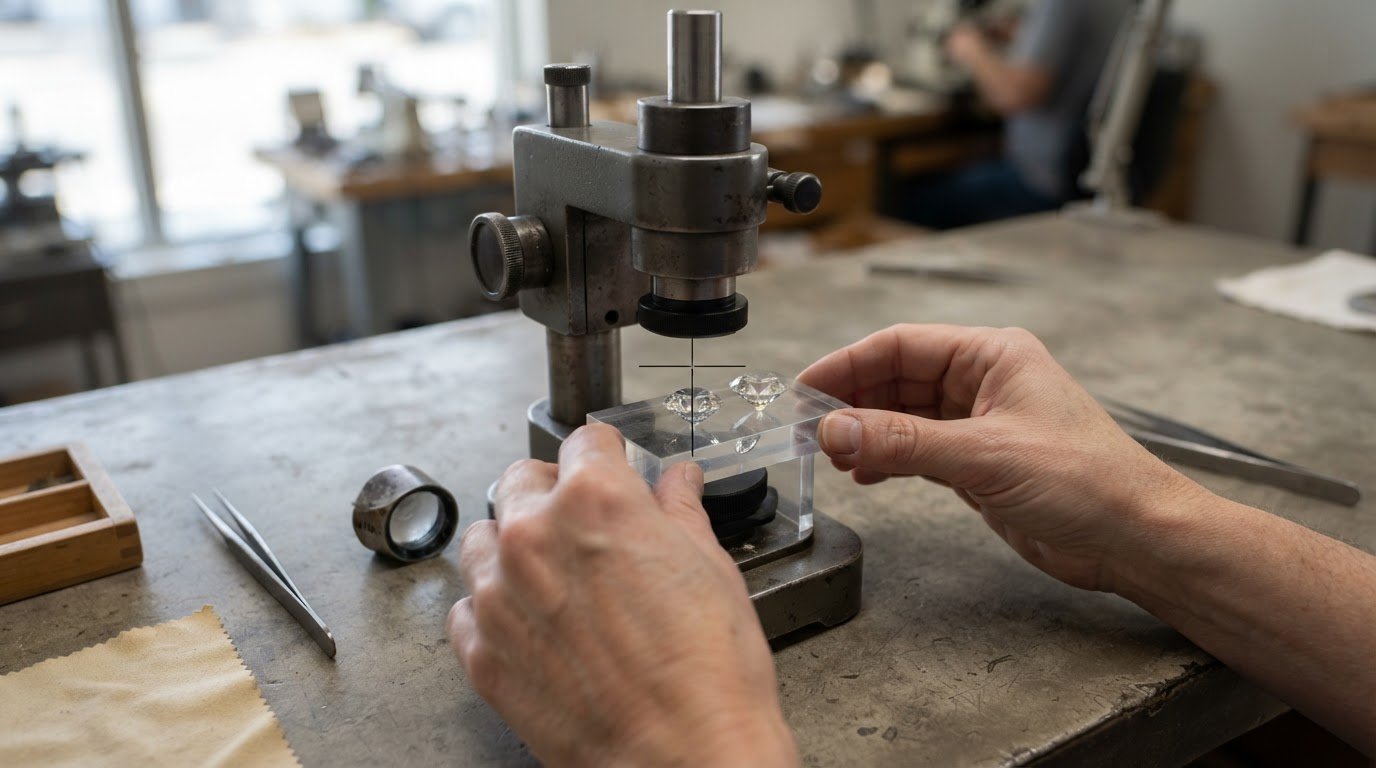
A diamond can carry more weight without looking larger or returning light as effectively. A round brilliant diamond cut proportions chart gives useful benchmarks: a table percentage of 53%-58% and total depth of 59.0%-62.5%. According to GIA, total depth is expressed as a percentage of the diamond’s average girdle diameter, so the figure helps show how the stone’s height relates to its width.
Depth matters when comparing diamonds, but no single measurement explains sparkle on its own. Crown angle, girdle thickness, culet size, and the balance of the diamond’s proportions also affect how light moves through the stone. This guide explains what depth means, how key proportions influence brilliance, and how to use a chart as a starting point when assessing a round brilliant diamond.
Key Takeaways
- Use a proportions chart as a comparison tool, then assess how the measurements work together rather than relying on one number.
- See how crown angle, girdle thickness, and culet size can influence a round brilliant diamond’s appearance and light return.
- Learn why a diamond that is too deep or too shallow may not reflect light as effectively.
- Use magnified photographs and 360° video of the exact diamond to understand details a grading report may not show clearly.
Crown angle, girdle thickness, and culet size
These measurements show how the upper and lower sections of a round brilliant meet, and how its edge and bottom are finished. Angle ranges offer useful benchmarks, but the measurements need to be considered together.
Crown and Pavilion Angle Ranges
The crown angle measures the slope above the girdle, while the pavilion angle measures the slope below it. Round brilliant benchmarks commonly place crown angles at 34.0°-35.0° and pavilion angles at 40.6°-41.0°. Together, these angles help direct light through the diamond and back toward the viewer. A mismatch can affect light return even when each angle looks close to its benchmark. A 1° deviation in pavilion angle can significantly reduce brilliance, so compare both angles rather than judging the crown alone.
Girdle Thickness and Culet Size
The girdle is the narrow edge between the crown and pavilion; its thickness describes how broad that edge is. A very thick girdle can add weight without adding much face-up size, while a very thin edge may be more exposed to damage. The culet is the facet, or point, at the bottom of the pavilion. Its size affects whether that area appears as a visible opening when viewing the diamond from above. These details help explain appearance and durability, not just a grade.
Read the measurements as a connected profile. For example, a crown angle near 35.0° should be considered alongside the pavilion angle, girdle description, and culet size, not treated as a standalone verdict. Facets meet at these transitions, shaping how light travels through the stone. A proportions chart helps you measure and compare those relationships, while the diamond’s actual appearance shows how they come together. Use the figures as a guide to interpretation, rather than assuming one measurement alone determines sparkle.
How diamond cut affects light reflection and sparkle
A standard round brilliant has 58 facets arranged to manage incoming light. Proportions, facet symmetry, and polish influence how that light returns to the eye.
“Ideal,” “Excellent,” and “Very Good” describe cut-grade categories, but the terms aren’t interchangeable across grading systems. GIA doesn’t provide a universal cut scale and grades cut only for round brilliant diamonds.
Proportions and Light Return
Light return describes how effectively a diamond sends light entering its top back through its crown. Balanced proportions help direct that light toward the viewer, while a poorly proportioned stone can leak light through the pavilion or sides. For example, a diamond that’s too deep may redirect light internally instead of returning it upward. That’s why proportions matter beyond the carat weight on a report.
Cut Quality and Light Performance
Cut quality considers how proportions, symmetry, and facet arrangement work together to shape a diamond’s appearance. “Ideal,” “Excellent,” and “Very Good” are grade labels, not identical measurements; their meaning depends on the grading system. A grade can guide comparison, but diamonds within the same category may still look different. Compare the recorded proportions with the stone’s actual appearance.
Brilliance, Fire, and Scintillation
Brilliance is the white light reflected from a diamond, fire is its coloured flashes, and scintillation is the pattern of flashes as the stone or viewer moves. Proportions affect how light enters, bends, and exits through the facets, influencing all three effects. Symmetry helps create an organized pattern. A poorly balanced arrangement can produce uneven brightness or less distinct flashes, even when the diamond has many facets.
GIA and AGS Proportion Grading
GIA evaluates round brilliant cut using factors including depth, table percentage, and crown measurement; it doesn’t offer a universal cut scale. GIA and AGS grades should be read within their respective grading systems, not assumed to be direct equivalents. For a practical comparison, review the report’s measurements alongside the diamond’s face-up appearance. No single proportion figure describes a stone’s complete light performance.
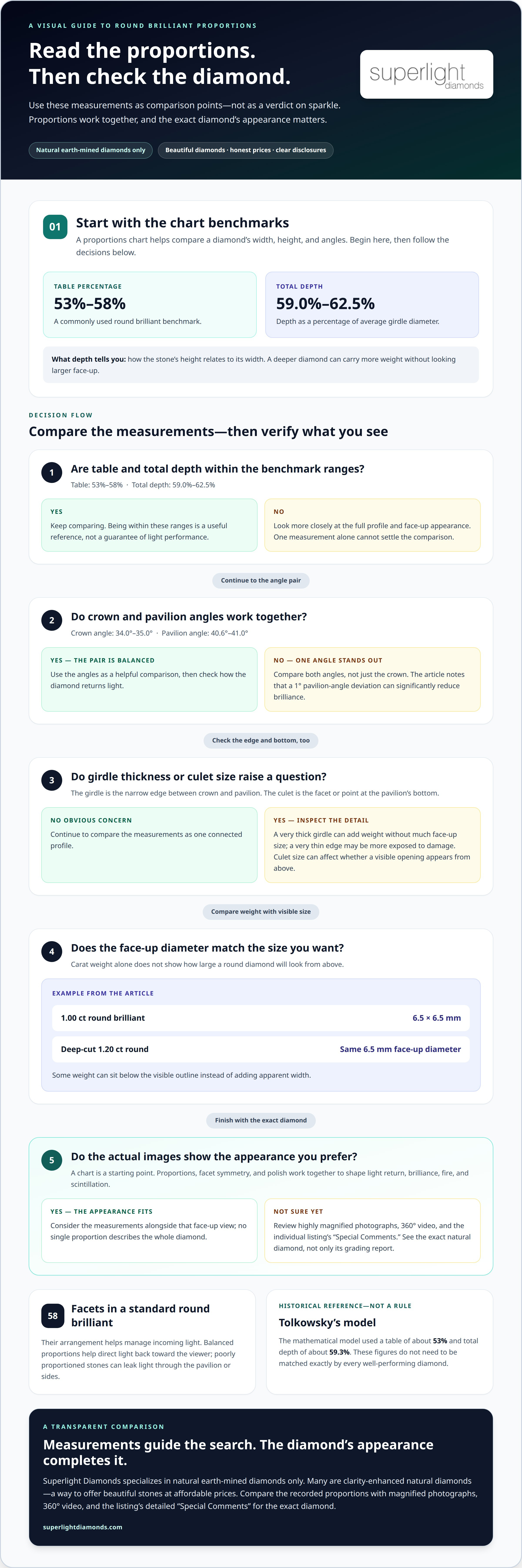
Round brilliant diamond cut proportions
A round brilliant diamond cut proportions chart helps compare a stone’s measurements as a connected profile. Its value lies in showing relationships, not in identifying one perfect combination for every diamond.
Round Brilliant Proportion Features
Proportion records describe how a round brilliant’s parts relate to one another, including table diameter, pavilion depth, crown angle, girdle thickness, and culet size. Consider these details together: a measurement that looks appealing on its own may have a different effect when paired with another proportion. This approach helps you interpret grading information without treating one figure as a complete assessment.
Marcel Tolkowsky’s mathematical model of the ideal round brilliant used a table of about 53% and total depth of about 59.3%. These figures are useful historical reference points, not a requirement that every well-performing diamond match the model exactly. A chart can make comparisons easier, but the proportions should still be read alongside the individual stone’s appearance and grading information.
Proportions by Diamond Size and Carat Weight
Recommended proportions don’t change simply because carat weight changes, but a diamond’s visible size can differ from its weight. For example, a 1.00 ct round brilliant has an average face-up dimension of 6.5 × 6.5 mm, while a deep-cut 1.20 ct round diamond can have the same 6.5 mm face-up diameter. Some weight may sit below the visible outline instead of increasing the apparent width.
Use the round brilliant diamond cut proportions chart to compare listed measurements, then consider the stone’s diameter and the face-up size you prefer. Carat weight alone doesn’t tell you how large a diamond will look. Explore round brilliant diamonds with these comparisons in mind.
Superlight Diamonds: Round Brilliant Diamonds
Superlight Diamonds is a natural next step if you’re using proportion measurements to compare round brilliant diamonds. The company specializes only in natural earth-mined diamonds, with round brilliant stones for buyers weighing cut details, face-up appearance, and value.
Most of the inventory consists of clarity-enhanced natural diamonds. This process helps make beautiful natural diamonds more affordable, and listings disclose relevant details through highly magnified photographs, 360° videos, and individual “Special Comments.” Reviewing images and video of the exact stone adds visual context that a grading report alone may not provide.
Explore the listed measurements and visual details together to find a diamond that fits your priorities. For help considering a round brilliant diamond, contact Superlight Diamonds.
Choose the diamond that fits your priorities
Use a round brilliant diamond cut proportions chart as one reference while deciding what matters most to you: visible size, appearance, or balancing these qualities within your budget. The best choice is the one whose documented details and actual appearance suit your preferences, rather than a number chosen in isolation.
Superlight Diamonds offers round brilliant and princess cut diamonds, including clarity-enhanced natural diamonds. Reviewing the exact stone’s listing details can help you make a considered choice. Contact Superlight Diamonds to discuss your diamond priorities and take the next step with confidence.
Frequently Asked Questions
What Is Diamond Depth?
Diamond depth is the vertical distance from the table, the top facet, to the culet at the bottom. GIA expresses total depth as a percentage of the average girdle diameter, relating height to width rather than giving height alone. This percentage helps compare how much of a diamond’s weight sits below its visible outline.
What Is a Diamond Table?
The table is the large, flat facet at the top of a round brilliant diamond. Its percentage compares the table’s diameter with the diamond’s average girdle diameter. A grading report may list this figure beside depth and other measurements. Read the values together: table percentage describes one part of the stone, not its overall cut or appearance.
What are the ideal proportions for a round brilliant diamond?
There is no single combination that guarantees an ideal appearance for every round brilliant. Common benchmarks include a table of 53%-58%, total depth of 59.0%-62.5%, crown angle of 34.0°-35.0°, and pavilion angle of 40.6°-41.0°. Use these as comparison points, then consider how the measurements work together and how the specific diamond looks.
What table percentage is recommended for a round brilliant cut diamond?
A table percentage of 53%-58% is a commonly used benchmark for round brilliant diamonds, with about 54%-57% often described as a balanced range. Read the figure alongside depth and the other proportions rather than treating it as a stand-alone quality verdict. A grading report provides the table measurement for the specific stone.
What depth percentage is recommended for a round brilliant cut diamond?
A total depth of 59.0%-62.5% is a commonly used benchmark for a round brilliant diamond. This percentage compares the stone’s height with its average girdle diameter. Diamonds within that range can still differ in appearance, so consider depth alongside table size, angles, and the individual stone’s face-up look.
How are round brilliant diamonds graded and certified?
Diamonds are typically certified by IGL (International Gemological Laboratories), and grading reports can also come from other laboratories. For round brilliant cut grading, GIA considers factors such as depth, table percentage, and crown measurement. Read a report as a structured description of the diamond, then consider the stone’s actual appearance rather than relying on a single grade alone.
Ideal Diamond Depth and Table Percentages for Round Diamonds
A round diamond’s sparkle depends on more than carat weight. The ideal diamond depth and table percentage ranges for a round brilliant are about 59% to 62.6% depth and 54% to 57% table, with the rest of its proportions also affecting how it handles light.Table percentage compares the width of a diamond’s flat top facet [...]