Loading... Please wait...
 USD



Recent Posts
Princess Cut Diamond Corner Chipping Prevention: How Settings Help
Posted on

At Superlight Diamonds, we specialize in natural earth-mined diamonds, with beautiful options at honest prices and transparent disclosures. A princess-cut diamond can be durable and still chip at a pointed corner. Its four exposed corners concentrate the force of a knock in a small area, so princess cut diamond corner chipping prevention depends on thoughtful setting design and everyday care.
Protective V-prongs cover the corners, while a bezel can shield more of the diamond’s edge; neither makes a stone immune to damage. If a chip occurs, stop wearing the ring and have the diamond assessed, since repair options depend on the damage and the stone. This guide explains why princess cuts are vulnerable, how corner protection and setting height affect risk, and what to expect when a damaged diamond needs attention. You’ll also learn about the practical trade-offs between open settings that show more of the stone and designs that provide more coverage.
Key Takeaways
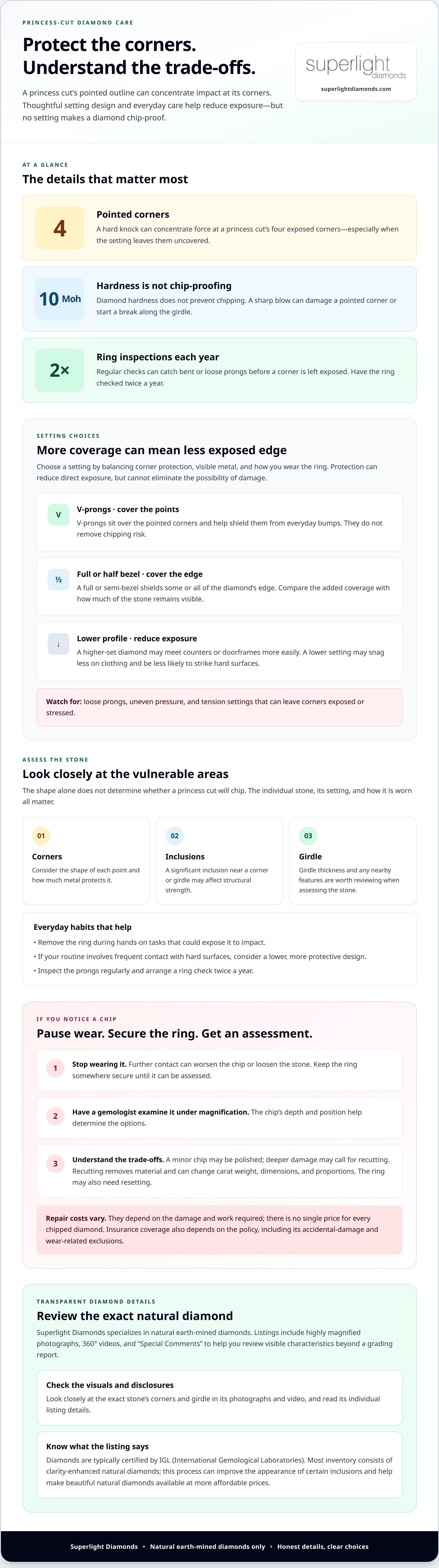
- Schedule a ring inspection twice a year to catch bent or loose corner-protecting prongs before a corner is left exposed.
- Even though diamond hardness is 10 Moh, sharp corners can still be vulnerable when a knock concentrates force in a small area.
- Corner or girdle inclusions and a very thin girdle can affect chipping risk, so these details matter when assessing a stone.
- When choosing a princess cut from Superlight Diamonds, review the exact diamond’s magnified photographs, 360° video, and Special Comments to understand its visible characteristics.
Does the Setting Matter More Than the Shape?
A setting can reduce exposure, but it cannot change a princess cut’s pointed outline. Protection depends on coverage at the corners, a secure fit, and habits that limit hard knocks.
Choosing Settings for Vulnerable Corners
A protective setting places metal around vulnerable areas of the stone to reduce direct impact. V-prongs cover a princess cut’s pointed corners, helping shield them from everyday bumps, though no setting can guarantee against chips. A full or semi-bezel provides more edge coverage. Choose a design by balancing corner protection, visible metal, and how you wear the ring.
Setting Height and Snag Risk
Setting height describes how far a diamond sits above the finger. A higher profile can expose it to more bumps, while a lower-set stone is less likely to strike counters or doorframes and may snag less on clothing. Remove the ring during hands-on tasks that could expose it to impact. If your routine involves frequent contact with hard surfaces, consider a lower, more protective design.
Prongs, Bezels, and Corner Protection
V-prongs cover pointed corners, but they can’t eliminate chipping risk. Full or half-bezel settings shield some or all of the edge. Avoid tension settings, loose prongs, and uneven pressure that can leave corners exposed or stressed. According to Gemological Institute of America, diamond hardness is 10 Moh, but hardness doesn’t prevent chipping. Inspect prongs regularly, and have the ring checked twice a year.
Do princess cut diamonds chip easily?
Princess-cut diamonds can chip, but the shape alone does not determine the outcome. A princess cut has four pointed corners where a hard impact can concentrate force in a small area. These points are more exposed than the rounded edge of a round diamond, especially when the setting leaves them uncovered. Effective princess cut diamond corner chipping prevention starts with understanding this difference.
Diamond hardness does not mean immunity to chipping. A sharp blow can cause damage, and a fracture may follow a cleavage plane, where the crystal can split more readily. Risk also depends on the individual stone: a significant inclusion near a pointed corner or girdle can create a structural weakness. For example, a corner inclusion deserves closer attention than one away from an exposed edge.
Everyday contact matters. A corner may strike a countertop, doorframe, or another hard surface while the ring is being worn. A secure setting can reduce direct exposure, while a bezel covers some or all of the diamond’s perimeter. Neither design makes a diamond chip-proof. Princess cut diamond corner chipping prevention also means balancing coverage with how much of the stone remains visible.
Whether diamond insurance covers chips and corner damage depends on the policy. Coverage and exclusions vary, so read the terms for accidental damage and wear-related exclusions before relying on insurance for this type of repair.
For a practical assessment, consider the shape of each corner, nearby inclusions, girdle thickness, and how much metal protects each point. These details help you understand the stone’s exposed features and the care its setting may require.
Diamond chipping and repair
A chip is a fragment missing from a diamond, often at an exposed corner or along the girdle. A hard impact can start a break that extends down the side of the stone. Stop wearing the ring if you notice damage, as further contact can worsen the chip or loosen the stone. Keep it somewhere secure until it can be assessed.
Repair costs vary with the damage and work required, so there is no single price for fixing or recutting every chipped princess cut. A professional may polish a minor chip or recut the diamond if the damage is deeper. Recutting removes material and can change the stone’s carat weight, dimensions, and proportions. Understanding these trade-offs before choosing a setting and wearing the ring is a practical part of princess cut diamond corner chipping prevention.
A gemologist can examine the damage under magnification and explain the options. The chip’s depth and position matter: a small nick at one corner may call for different treatment than a fracture extending along the girdle. Ask how the proposed work could change the finished appearance and whether the ring will need resetting.
Repair may not restore the diamond’s original shape or size. If the chip is extensive, the condition of the remaining stone helps determine whether recutting is worthwhile. Good princess cut diamond corner chipping prevention also means acting promptly after damage and avoiding forceful cleaning while the ring is affected.
For a future purchase, review natural diamond details carefully, including the exact stone’s images and disclosed characteristics.
There is no single repair price. The cost depends on the damage and the work required, such as polishing a minor chip or recutting a deeper one.
Superlight Diamonds: Princess Cut Diamonds
Superlight Diamonds helps shoppers compare natural earth-mined princess cut diamonds and review each stone’s disclosed characteristics before choosing. Diamonds are typically certified by IGL (International Gemological Laboratories), and individual listings also include highly magnified photographs, 360° videos, and “Special Comments.” These details help you assess the exact diamond beyond its grading report.
Most of the inventory consists of clarity-enhanced natural diamonds. This process can improve the appearance of certain inclusions and help make beautiful natural diamonds available at more affordable prices. Review each listing’s details and visuals, especially around a princess cut’s corners and girdle. If you’re weighing shapes, compare princess cuts with round brilliant or cushion cut diamonds and consider which outline suits your preferences.
Contact Superlight Diamonds to discuss choosing a natural diamond that fits what you’re looking for.
Choose a Diamond That Fits Your Everyday
Your choice can reflect how you use your hands, the look you prefer, and the balance you want between visible size and corner coverage. Thoughtful princess cut diamond corner chipping prevention starts before you wear the ring: consider the stone’s exposed areas alongside the setting that will hold it, rather than choosing by shape alone.
Superlight Diamonds specializes only in natural earth-mined diamonds, including Princess Cut Diamonds, Round Brilliant Diamonds, and Clarity Enhanced Diamonds. Our focus is beautiful natural diamonds at honest prices, with outstanding value. Clarity enhancement improves the appearance of some natural diamonds and can offer another way to find beauty at an affordable price. Review the exact stone’s magnified photographs, 360° video, and listing comments, then decide which characteristics matter most to you.
For a clear next step, contact Superlight Diamonds to discuss what you’re looking for. Take the time you need to make a choice that feels right for your preferences and budget.
Frequently Asked Questions
Can a chipped princess cut corner be fixed?
A diamond professional may improve a chipped corner by polishing or recutting the stone, depending on the damage. A small nick may require less material to be removed than a deeper break. Recutting can change the diamond’s dimensions and carat weight, so ask what visible changes to expect before approving the work. The ring may also need resetting afterward.
Do diamonds chip despite being so hard?
Yes. Hardness describes resistance to scratching, not resistance to every impact. A sharp blow can still chip a diamond, particularly where an edge or point is exposed. For example, striking a ring against a hard surface can damage a corner even if the diamond has not been scratched. Avoid wearing a damaged ring until the stone and setting are assessed.
Does a halo protect a princess cut’s corners?
A halo can add a layer around the center stone, but its protection depends on how the metal and surrounding stones sit beside each corner. A halo that leaves the points exposed will not shield them from direct contact. The design also has small stones and setting edges that can be affected by knocks. Examine the corner coverage, not just the halo’s outline.
How many prongs does a princess cut need?
There is no single required prong count for every princess cut setting. A common approach uses four corner prongs, with V-shaped prongs covering the pointed tips. Other designs may use additional prongs or different metal coverage. The key is a level fit, with each prong contacting the stone securely and no uneven pressure or gap at a corner.
Is a cathedral setting safe for a princess cut?
A cathedral setting can hold a princess cut securely, but its raised shoulders alone do not protect the corners. The prongs, stone seat, and amount of corner coverage all matter. For example, a cathedral ring with exposed tips can leave them vulnerable to knocks. Consider the diamond’s height and whether the setting suits your daily activities before choosing the design.