Loading... Please wait...
 EUR



Recent Posts
I Color Diamond vs J Color Diamond Face Up: How They Look
Posted on
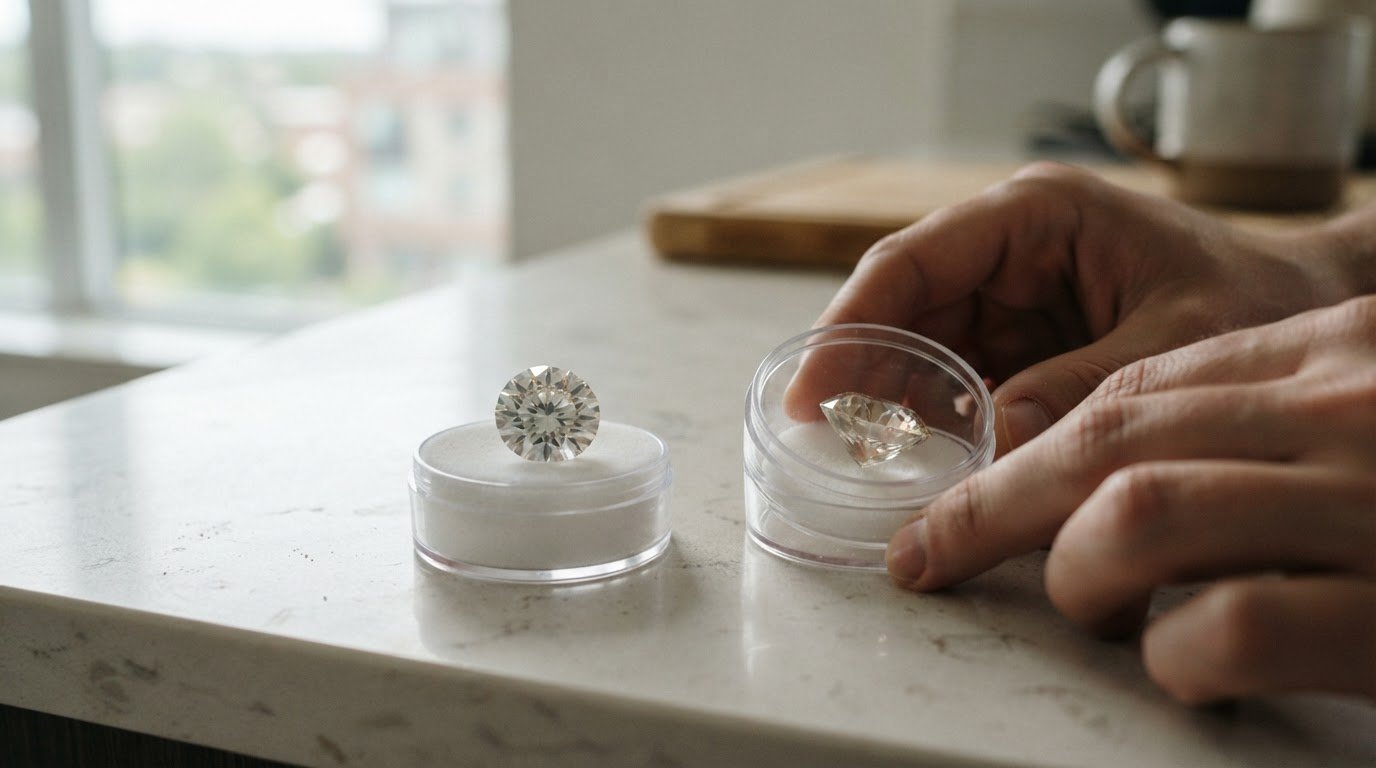
A J color diamond can look just as white face up as an I, especially in a round brilliant cut. In an I color diamond vs. J color diamond face-up comparison, the difference is often subtle, but size and shape can make warmth easier to notice.
It’s reasonable to expect the higher color grade to look visibly whiter. But a diamond’s face-up appearance also depends on how its facets return light, and a faint warm tint may be more noticeable from the side than from above.
This guide explains how carat size, diamond shape, and setting affect the visible warmth of I and J color diamonds. You’ll learn what to compare so you can weigh color against the size and sparkle you want.
Key Takeaways
- A J color diamond can appear white face up, while warmth may be easier to notice in a larger stone or from the side.
- Round brilliant facets can make subtle color less apparent; step cuts with broader facets tend to show body color more clearly.
- At Superlight Diamonds, compare a natural earth-mined diamond’s face-up appearance and side view for a transparent look at its beauty and value; its color grade alone doesn’t show exactly how it will look.
- Setting details matter: metal color and how much of the diamond’s sides are visible can affect the impression of warmth.
Diamond size and shape effects on visible warmth
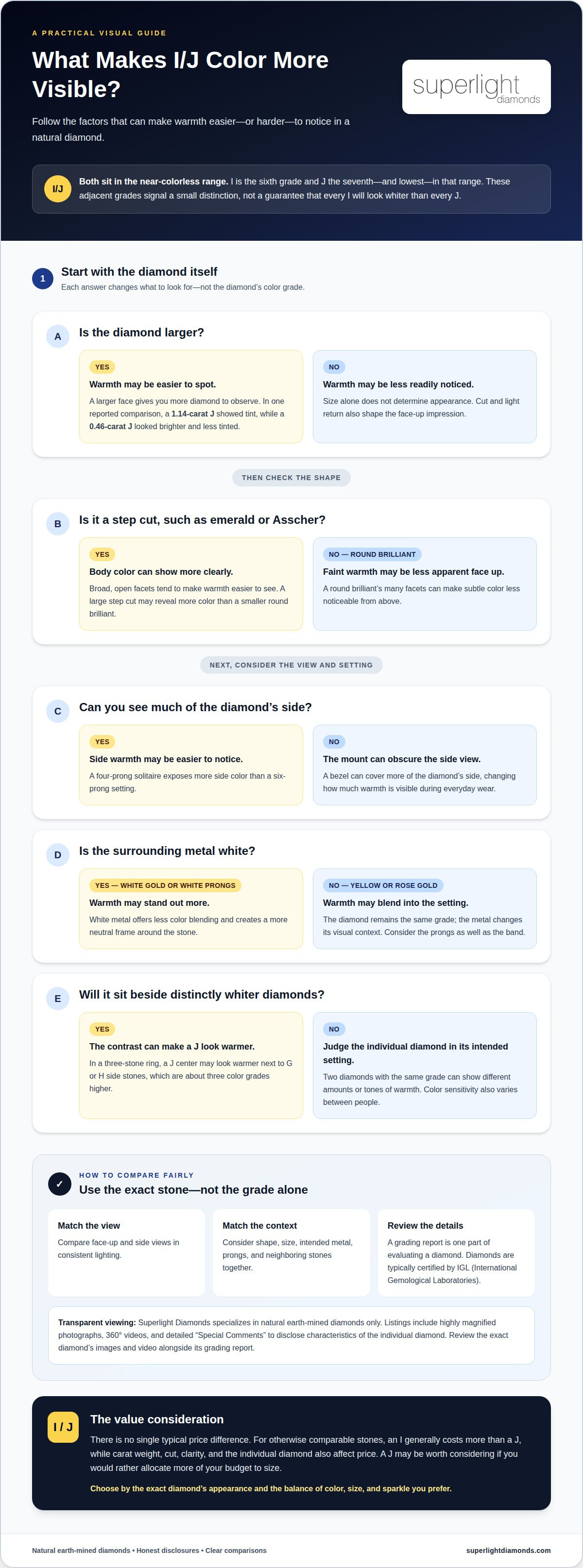
Carat size can change how readily you notice a diamond’s body color. A reported comparison described a 1.14-carat J diamond as showing tint, while a 0.46-carat J looked brighter and less tinted. A larger face gives you more diamond to observe, so subtle warmth may be easier to spot. Size alone doesn’t determine appearance, though; cut and light return also affect the face-up impression.
Shape matters because facets handle light differently. A round brilliant’s many facets can make faint warmth less noticeable face up. By contrast, step cuts such as emerald and Asscher have broad, open facets that can make body color easier to see. For example, a round J and an emerald-cut J of similar grade may show different amounts of warmth, with the emerald cut making more of its color visible.
The D-to-Z color scale places I and J in the near-colorless range, G through J. I is the sixth grade and third in that group; J is the seventh grade and lowest in the group. These adjacent grades indicate a small color distinction, not a guarantee that every I will look whiter than every J. Individual stones can show different amounts or tones of warmth. Diamonds are typically certified by IGL (International Gemological Laboratories).
There is no single typical price difference between I and J diamonds. For otherwise comparable stones, an I generally costs more than a J, while carat weight, cut, clarity, and the individual diamond also affect price. A J may be worth considering if you would rather allocate more of your budget to size.
Compare shape and size together, not in isolation. For a practical face-up comparison, view the exact diamonds in consistent lighting and consider both top and side views. A large step cut may reveal warmth more clearly than a smaller round brilliant.
How I and J diamonds look face up
Face-up appearance and a grading report’s color grade describe different aspects of a diamond. Diamonds are typically certified by IGL (International Gemological Laboratories), and a grading report is one part of evaluating a stone. A diamond’s body color can be easier to notice from the side than face up. An I or J may therefore appear whiter from above than its grade suggests, especially when light return draws attention to the facets.
An I color diamond vs J color diamond face up assessment should account for each stone’s individual appearance. Two diamonds with the same grade can show different amounts of tint. Color sensitivity also varies, so one person may notice a distinction another doesn’t.
Contrast can influence perception, too. In a three-stone ring, a J center diamond may look warmer beside G or H side stones, which are about three color grades higher. That contrast comes from the neighboring diamonds, not a change in the center stone’s color.
Fluorescence describes a diamond’s reaction to ultraviolet light, not its color grade. Blue fluorescence may be visible under UV-rich conditions, but it isn’t a dependable indicator of whether an I or J will look whiter face up.
For an I color diamond vs J color diamond face up decision, use the grade as one part of your assessment, not a complete prediction. Consider whether the diamond will sit beside distinctly whiter stones, since that contrast can affect how its color appears in a finished piece.
How setting style affects visible body color
Metal color changes the contrast around an I or J diamond. Yellow and rose gold can help a J diamond’s warmth blend with the setting. White gold offers less color blending, so warmth may stand out more against the bright metal. The diamond remains the same grade; the setting changes its visual context.
Prong design also affects how much of the diamond’s side is visible. A four-prong solitaire exposes more side color than a six-prong setting, while a bezel can obscure the side view. If warmth is most noticeable from the side, these mounting details can influence what you see during everyday wear.
For near-colorless diamonds in gold settings, white prongs provide a more neutral frame around the stone. This helps distinguish the diamond’s appearance from the surrounding yellow or rose gold. Compare the prongs as well as the band, since small metal details sit close to the diamond’s edge.
Shape and setting work together. A 4-carat J color emerald cut can show noticeable yellow tint because its broad facets make body color easier to see. Rose gold may help that warmth blend into the overall design, while white prongs can create more contrast. The preferred effect depends on whether you want the diamond’s warmth to blend or stand out.
To assess the combined effect, compare an I or J diamond in the intended metal and mount style, including its side profile. Compare natural diamond options while considering how the setting may frame each stone.
Superlight Diamonds
Superlight Diamonds helps shoppers compare diamond details that can affect how I and J colors look face up. The business specializes in natural earth-mined diamonds only, with options including round brilliant, princess cut, and cushion cut diamonds.
For a closer look beyond a grading report, listings include highly magnified photographs, 360° videos, and detailed “Special Comments” that disclose characteristics of the individual diamond. Review the exact stone’s images and video to assess its appearance, rather than relying on its color grade alone. Most inventory consists of clarity-enhanced natural diamonds, a process used to offer beautiful stones at affordable prices.
With over 20 years of experience and more than 21,000 satisfied clients, Superlight Diamonds focuses on honest disclosures and value. If you’d like help considering how a diamond’s color may appear, contact Superlight Diamonds.
Choose the Diamond That Fits Your Priorities
Choosing between an I color diamond and a J color diamond face up is a personal decision shaped by the qualities that matter most to you. Consider the balance you want between color and the stone’s other features, then decide which trade-offs feel worthwhile. A grading letter is useful, but your preferences should guide the final choice.
Before deciding, focus on the exact diamond’s disclosed details and appearance. This helps you assess the stone as an individual rather than relying on its grade alone. Prioritize the qualities you value most, whether that means a brighter appearance or another feature that better suits your plans.
Ready to consider your options? Contact Superlight Diamonds to compare options. A thoughtful comparison can help you move forward with confidence.
Frequently Asked Questions
Does carat size or shape change how J color looks?
Yes. Carat measures weight, not a diamond’s visible width or length. Different shapes and proportions can give stones of the same carat weight different face-up dimensions, changing how much of the diamond you see. When comparing two J diamonds of the same weight, consider their measurements rather than assuming they’ll look equally large.
J Color Diamonds: Good or Bad?
A J color grade isn’t a verdict on a diamond’s overall quality. Color, clarity, and cut describe different characteristics, so a J grade doesn’t tell you whether inclusions are visible or how well the facets are arranged. Evaluate those features separately, then decide which combination best fits your priorities and budget.
Does J color look yellow in white gold?
It can, but the white-gold setting isn’t always the only factor. White gold’s appearance can vary with its alloy and finish, so two rings described as white gold may frame the same J diamond differently. Consider the specific metal’s tone alongside the stone’s appearance when choosing a ring, rather than relying on the metal name alone.
Is I color good for an engagement ring?
Yes. I color can work well for an engagement ring, and the grade doesn’t restrict the ring to a particular style or design. Treat color as one part of the decision: consider how the diamond’s shape, clarity characteristics, and overall appearance fit the wearer’s preferences and your budget. The grading letter alone can’t determine the right choice.
Is a J Diamond Too Yellow?
No, not by definition. A J grade doesn’t mean every stone will appear distinctly yellow. If a listing describes a brown or gray undertone, account for that detail because the diamond’s overall color impression can include more than warmth. The individual stone’s documented characteristics help distinguish one J diamond from another.