Loading... Please wait...
 EUR
EUR


Recent Posts
Diamond Appraisal vs. Grading Certificate: What’s the Difference?
Posted on

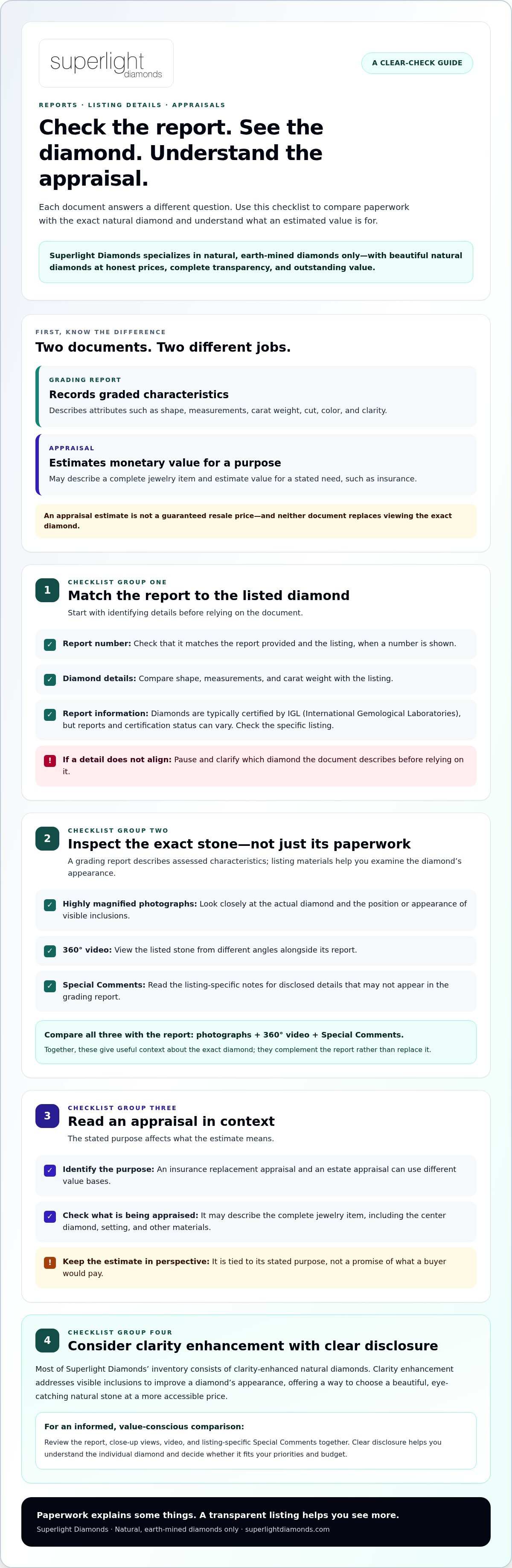
Could a grading certificate tell you what a diamond is worth? Usually, no. Understanding the diamond appraisal vs diamond grading certificate differences helps you know what each document can and cannot establish. A grading report records characteristics such as cut, color, clarity, and carat weight. An appraisal estimates monetary value for a stated purpose, such as insurance.
At Superlight Diamonds, we specialize in natural, earth-mined diamonds only. An informed purchase requires more than paperwork: a report describes graded features, but it may not show the exact diamond’s appearance or disclose every visible characteristic. This guide explains when each document is useful, what details to compare in a listing, and how magnified photographs, 360° videos, and listing-specific Special Comments help you assess the exact stone before deciding.
Key Takeaways
- Understand the diamond appraisal vs diamond grading certificate differences so you can distinguish a monetary estimate from a record of a diamond’s graded characteristics.
- Match identifying details on a grading report to the specific diamond in the listing before making a purchase decision.
- Consider the appraisal’s stated purpose, since insurance and other documentation needs can call for different types of value assessments.
- Learn how clarity enhancement can help make a natural diamond more affordable, and review listing details to assess the individual stone.
Diamond Appraisal vs. Grading Certificate: What Each Document Actually Tells You
A diamond grading report records assessed characteristics, while an appraisal estimates monetary value for a stated purpose. The documents answer different questions and aren’t interchangeable. This distinction matters when comparing a loose diamond with a finished piece of jewelry, since an appraisal may describe the complete item while a grading report focuses on the diamond.
Which details belong in a grading report, and which belong in an appraisal?
A grading report may identify a diamond’s shape, measurements, and carat weight, along with assessments of cut, color, and clarity. These are the four Cs used to describe key qualities. The Diamond (gemstone) overview provides general background on grading terminology. Diamonds are typically certified by IGL (International Gemological Laboratories), but reports and certification status can vary. Check the specific listing for the report details provided.
An appraisal may describe the complete jewelry item, including its center diamond, setting, and other materials, then estimate value according to its stated purpose. An insurance replacement appraisal and an estate appraisal can use different value bases, so read the figure alongside the purpose. It isn’t a guaranteed resale price or a promise of what a buyer would pay.
A grading report records characteristics; an appraisal provides a purpose-based monetary estimate.
That’s the practical answer to the diamond appraisal vs diamond grading certificate differences: a report helps you understand a diamond’s graded attributes, while an appraisal documents an estimate for a particular need. At Superlight Diamonds, we specialize in natural, earth-mined diamonds only. Use documentation to support your comparison, then consider whether the diamond’s characteristics and appearance fit your priorities and budget.
How to Use a Diamond Grading Report and Appraisal for a Purchase
Use the grading report to check that the diamond described on paper matches the one in the listing. Compare the report number, shape, measurements, and carat weight with the listing details. If a report number is shown, make sure it matches the report provided. If a detail does not align, pause and clarify which diamond the document describes before relying on it.
What should you compare before relying on a diamond document?
Start with identifying details, then inspect the actual stone. A report describes graded characteristics; images show the listed diamond. Superlight Diamonds provides highly magnified photographs and 360° videos of individual diamonds, along with Special Comments that disclose additional listing-specific details. Review these materials together so you can assess the exact stone, not just its report.
- Check that the report number and key diamond details align with the listing.
- Compare the report with magnified photographs and the 360° video of that exact diamond.
- Read Special Comments for listing-specific context that may not appear in the grading report.
An appraisal serves a different need. If you’re arranging insurance or keeping documentation, consider whether the appraisal’s stated purpose and type of value fit that need. The estimate isn’t a guaranteed resale price. The GIA: Diamond Grading Report vs. Appraisal resource also explains how these documents differ.
Understanding diamond appraisal vs diamond grading certificate differences helps you use each document for what it can tell you, without expecting either to reveal every visual detail. Superlight Diamonds specializes in natural, earth-mined diamonds only. To compare report details with close-up views, explore our natural loose diamonds.
Choosing a Transparent Natural Diamond: Reports, Images, and Honest Disclosures
Superlight Diamonds specializes in natural, earth-mined diamonds only. Most of our inventory consists of clarity-enhanced natural diamonds. Clarity enhancement addresses visible inclusions to improve a diamond’s appearance, offering a way to choose a beautiful, eye-catching stone at a more accessible price. Clear disclosure helps you understand the diamond and decide whether it suits your priorities and budget.
Why the exact diamond’s listing matters alongside its report
A grading report offers structured information, but it can’t show every detail of an individual stone’s appearance. Review the listing’s highly magnified photographs and 360° video to examine the actual diamond from different angles. Then read its Special Comments for additional information about disclosed characteristics. Together, these listing-specific resources provide useful context that a report alone may not convey.
Close-up inspection can help you compare diamonds with similar report details but different visible features. Magnification may show the position or appearance of an inclusion, while the rotating video offers another view of the stone. Use these materials alongside the report, not as a replacement for it. The diamond appraisal vs diamond grading certificate differences matter, but a document should not be your only view of the exact stone.
If you’re comparing shapes, a guide to buying round brilliant loose diamonds can help clarify what to consider for that cut. If you’re assessing treated stones, a clarity-enhanced diamond buyer’s guide can explain the process and the disclosures to review. Superlight Diamonds has served customers since 2001 and has more than 21,000 satisfied clients.
Review the report, close-up views, video, and Special Comments together. This simple step supports a transparent, value-conscious choice based on the diamond itself.
Make Your Next Diamond Decision with Confidence
Let your priorities guide the final choice. Decide what matters most within your budget, whether that’s shape, face-up size, or a balance of color and clarity. Then compare options using their documentation and the details shown for each stone. The diamond appraisal vs diamond grading certificate differences are useful to understand, but your choice also depends on how the individual diamond looks to you and whether its disclosures are clear.
Superlight Diamonds specializes in natural, earth-mined diamonds, with a focus on honest pricing and transparent information. Explore natural loose diamonds with transparent listing details and compare the options against what matters to you.
A thoughtful comparison can help you choose a diamond that feels right for both your preferences and your budget.
Frequently Asked Questions
Can a diamond grading report tell me what my diamond is worth?
No. A grading report doesn’t assign a monetary value. It can help you compare diamonds with similar documented characteristics, but it can’t tell you what a particular buyer will pay. The diamond appraisal vs diamond grading certificate differences come down to their purposes: use grading details to understand a stone, and an appraisal when you need an estimate of its monetary worth.
How often should a diamond appraisal be updated?
There isn’t one update schedule that suits every diamond or purpose. Review the appraisal if the jewelry changes, the document no longer reflects the item, or your insurer asks for updated documentation. For example, a new setting could make an appraisal describing the previous piece incomplete. Check the appraisal’s stated purpose and date to decide whether it still meets your documentation needs.
Does a diamond appraisal guarantee what I can sell the diamond for?
No. An appraisal estimates value for its stated purpose; it doesn’t promise a future sale price. The amount someone may offer can depend on the specific stone, its condition, the buyer, and the terms of the transaction. Treat an appraisal as documentation, not a guaranteed return, and avoid using an insurance replacement estimate as a prediction of what you’ll receive in a sale.