Loading... Please wait...
 EUR
EUR


Recent Posts
Avoid Retail Diamond Markup: A Savvy Buyer's Guide
Posted on

The steep price tag on a luxury showroom diamond often has very little to do with how much it sparkles on a finger. Most buyers unknowingly pay a massive premium for a jeweler's expensive overhead and national marketing campaigns rather than the quality of the actual stone. If you want to avoid retail diamond markup, you must look past the velvet lighting and understand the cold mechanics of the global supply chain. It's a common frustration to see two stones that look identical to the naked eye but carry price tags thousands of dollars apart.
It's understandable to feel intimidated by high-pressure sales environments or confused by microscopic quality differences you can't even see. This guide will show you how to bypass these unnecessary layers to secure a beautiful natural diamond without the traditional retail premium. You'll learn the professional strategies used by market veterans to identify pricing red flags. We'll also explain how the US natural diamond price index, which reached $4,456 per carat in March 2026, impacts your purchasing power and how you can use that knowledge to get a larger, more impressive stone for your budget.
Key Takeaways
- Identify how the traditional diamond supply chain adds percentage-based markups at every stage from the mine to the showroom.
- Learn how to leverage direct-to-consumer e-commerce and no-reserve auctions to discover the true market value of loose natural diamonds.
- Discover specific tactical choices, such as clarity enhancement, that allow you to avoid retail diamond markup while securing a larger stone for your budget.
- Understand the role of objective certifications and magnified 360-degree videos in making an informed purchase without paying a luxury brand premium.
What is Retail Diamond Markup and Why Does it Exist?
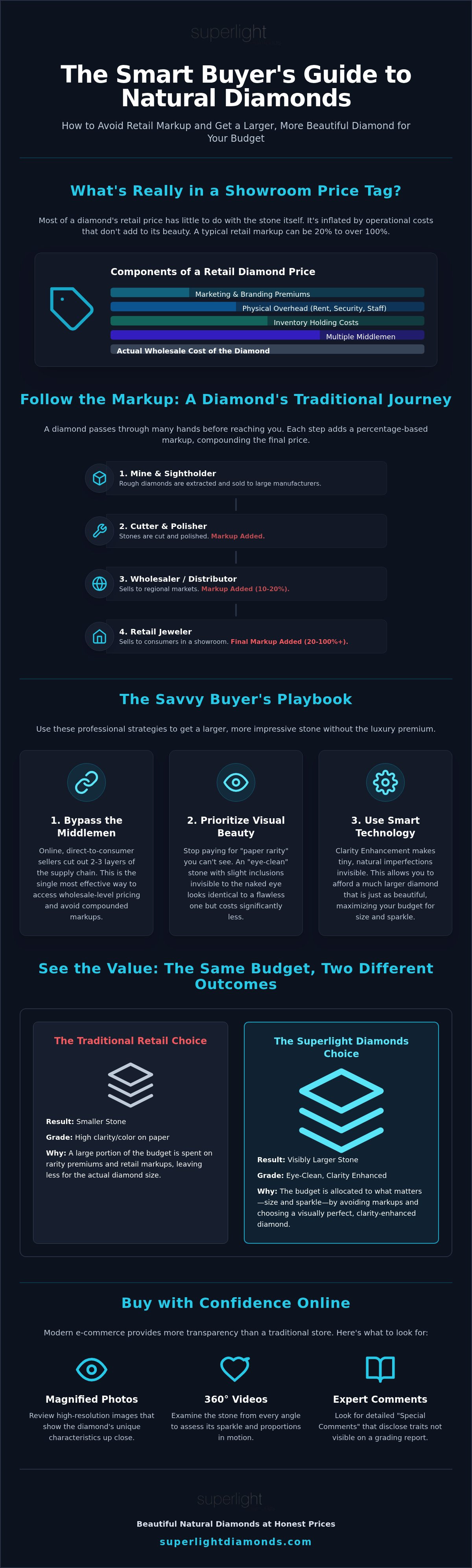
Retail diamond markup represents the price difference between a stone's wholesale acquisition cost and the final figure on a consumer's receipt. While wholesale prices are dictated by global market fluctuations and gemological grading, retail prices are heavily influenced by a store's specific business model. To avoid retail diamond markup, you have to understand that these premiums usually start at 20% but can exceed 100% at prestigious luxury brands. This markup isn't a fee for better quality; it's a contribution to the jeweler's operational expenses.
High-end branding creates a luxury illusion where consumers believe a higher price naturally correlates with a more beautiful stone. In reality, the physical properties of a diamond don't change based on the box it comes in. Understanding the diamond investment market reveals that retail markups often evaporate immediately after purchase. This happens because the resale value is based on the stone's intrinsic qualities rather than the brand name or the store's marketing budget.
The Components of a Jewelry Store Price Tag
Traditional brick and mortar jewelers face significant financial burdens that online or high-volume wholesalers don't. When you walk into a prestigious showroom, several hidden costs are baked into the price of every Round Brilliant or Princess Cut diamond:
- Physical overhead: Prime retail locations require expensive leases, high-end security systems, and specialized insurance.
- Inventory holding costs: A jeweler might keep millions of dollars in inventory on display for months or years before a specific stone sells. The interest and capital tied up in this stock are passed directly to the buyer.
- Marketing premiums: National advertising campaigns and iconic branding require massive budgets. Customers pay for this perceived prestige through inflated prices that have nothing to do with gemological value.
Rarity vs. Beauty: The Hidden Markup
The diamond industry often prioritizes paper rarity over visual appeal to justify higher prices. This is one of the most effective ways to avoid retail diamond markup: stop paying for perfection you can't see. A stone with a Flawless clarity grade carries a massive price jump compared to a Slightly Included (SI) stone. However, these microscopic inclusions are often invisible to the naked eye.
Savvy buyers focus on eye-clean diamonds. These stones look identical to their perfect counterparts under normal viewing conditions but cost significantly less because they lack the rarity premium. Choosing beauty over technical perfection allows you to allocate your budget toward a larger, more impressive stone. Retailers often push high-grade stones because the percentage-based markup on a more expensive diamond yields a higher profit, even if the visual difference is non-existent to the customer.
The Diamond Supply Chain: Identifying the Middlemen
A natural diamond typically passes through five or six different hands before it ever reaches a jewelry counter. The journey begins at the mine, where rough stones are sold to sightholders or large-scale manufacturers. These entities sell to cutters, who then sell polished stones to international wholesalers. Finally, the wholesaler sells to a regional distributor or a retail jeweler. Every time a diamond changes hands, a percentage-based markup is added to cover labor, shipping, insurance, and profit margins. To avoid retail diamond markup, you must understand that the final consumer often pays for every single one of these transfers.
Buying a loose stone is the most effective way to see the true cost of a diamond. Retailers frequently sell "pre-set" rings where the mounting obscures the diamond's girdle or hides inclusions near the prongs. This practice makes it difficult to evaluate the stone's actual quality. When you purchase loose diamonds, you aren't just seeing the stone clearly; you're also stripping away the additional markup applied to the metalwork and labor of the setting. It allows for a clinical, objective evaluation of the gem's intrinsic value.
Wholesale vs. Retail Access
Traditional jewelers usually lack direct access to the primary cutting houses. They rely on regional wholesalers who have already applied their own 10% to 20% margin. By the time the retailer adds their overhead, the price has inflated significantly. Monitoring U.S. diamond price indexes shows how these costs fluctuate at the import level, yet retail prices rarely drop when wholesale costs decrease. Direct-to-consumer models eliminate two or three of these middleman layers, passing those savings directly to the buyer.
The Role of High-Volume Turnover
The business model of a brick and mortar store relies on high margins because their sales volume is low. A local jeweler might only sell a few significant Round Brilliant or Princess Cut diamonds a month. They must make enough profit on each sale to cover a month of rent and staffing. High-volume online wholesalers operate on a different scale, prioritizing rapid turnover with lower individual margins. You can often find a much wider selection of natural earth-mined diamonds through these high-volume platforms than in a limited physical inventory. No-reserve auctions are the most transparent pricing mechanism because they allow the global market to dictate value without artificial retail floors. This transparency is the ultimate tool for those who want to avoid retail diamond markup and pay what a stone is actually worth.
How to Bypass Fixed Retail Pricing Strategies
Traditional jewelers rely on fixed pricing models designed to protect their high overhead and inventory costs. To avoid retail diamond markup, savvy buyers utilize digital marketplaces to compare thousands of Round Brilliant or Princess Cut diamonds simultaneously. This level of transparency forces prices toward actual market value rather than arbitrary retail figures. Online environments allow for instant filtering by carat weight, cut, and color; providing a breadth of data no physical showroom can match. You can quickly identify which stones offer the best visual value without being pressured by a salesperson on commission.
Mastering the Online Auction
No-reserve auctions represent the purest form of price discovery in the gemstone industry. Instead of a jeweler deciding what a stone is worth, the global market determines the final value through competitive bidding. This model effectively strips away the layers of retail inflation discussed in previous sections. When evaluating auction sellers, prioritize those with veteran status and a long history of high-volume transactions. A seller with 20+ years of experience and over 21,000 satisfied clients provides the necessary security for such a significant purchase. For a detailed strategy on this process, review our guide on Mastering No-Reserve Loose Diamond Bidding. No-reserve auctions are the most transparent pricing mechanism because they prevent artificial price floors from being enforced by the seller.
Visual Verification vs. Certificate Reliance
A grading report is a technical map, not a visual guarantee. Two diamonds with identical grades can look vastly different in person due to the placement of inclusions or the precision of the cut. Relying solely on a certificate is a common mistake that leads to paying for microscopic quality you can't see. High-magnification photography and 360-degree videos are essential for verifying a stone's true character before you commit to a purchase. You should always insist on seeing the actual stone rather than generic stock images used by many large retailers.
Detailed 'Special Comments' from a professional gemologist often reveal nuances that a standard grading report misses. These comments might highlight that a stone is eye-clean despite a lower clarity grade, or note exceptional fire and brilliance. By prioritizing visual evidence over paper grades, you can avoid retail diamond markup associated with perfect technical specifications that offer no visible benefit. This approach ensures you pay for the beauty of the diamond rather than its statistical rarity on a document. Professional sellers who provide magnified media and expert commentary allow you to act as a savvy participant in the market.
Tactical Choices: Clarity Enhancement and Certification
Selecting specific gemological paths allows you to avoid retail diamond markup by targeting stones that offer the highest visual impact for the lowest relative cost. Traditional retailers often push high-margin, technically perfect stones because they're easier to sell to buyers who haven't studied the market. A more effective strategy involves selecting natural diamonds with specific enhancements or certifications that prioritize the stone's appearance over its paper rarity. This shifts your investment from invisible technical grades to the actual brilliance of the gem.
The Value of Clarity Enhancement
Clarity enhancement is a professional process that addresses natural inclusions, such as feathers, within a diamond. By filling these microscopic reaches with a specialized substance that mimics the diamond's refractive index, the inclusion becomes nearly invisible to the naked eye. This tactical choice allows you to secure a natural, earth-mined diamond for 30% to 50% less than an untreated stone of the same visual grade. It's a transparent and honest method to maximize your budget while maintaining the prestige of a natural gemstone. For a deeper look at this technology, read our guide on Clarity Enhanced Diamonds: The Savvy Buyer’s Guide. This approach ensures you aren't paying a premium for rarity that doesn't translate into a more beautiful ring.
Demystifying Diamond Certification
Many buyers are led to believe that only one or two grading laboratories are valid. In reality, labs like IGL (International Gemological Laboratories) provide rigorous, objective grading standards that are respected across the industry. Chasing a specific lab's name often results in a "brand tax" that adds thousands to the price without changing the stone's physical properties. The goal of certification is objective disclosure, not a price-justification tool. By choosing an IGL-certified stone, you receive a professional gemological evaluation without the inflated costs associated with more famous marketing-heavy laboratories.
Prioritizing Visual Impact Over Paper Grades
To truly avoid retail diamond markup, you should focus your budget on the "Cut" grade rather than chasing D-Flawless clarity. A well-cut stone with slightly lower color or clarity will always outshine a poorly cut stone with perfect technical specs. The savings you generate from choosing clarity-enhanced stones or objective certifications can be reinvested into a significantly larger carat weight or a more intricate high-quality setting. This ensures the final piece of jewelry has the maximum possible presence on the hand. If you're ready to see how much more diamond your budget can buy, browse our collection of clarity enhanced diamonds to find a stone that prioritizes beauty over retail markups.
Conclusion: Finding Honest Value with Superlight Diamonds
To avoid retail diamond markup, you must commit to a buying strategy that bypasses traditional middlemen and ignores the artificial premiums of luxury branding. By purchasing loose, natural earth-mined diamonds directly from a high-volume source, you ensure your investment pays for the stone's physical beauty rather than a jeweler's rent. The most successful buyers prioritize visual sparkle and carat weight over technical paper perfection. Beauty shouldn't be invisible.
Why 21,000+ Customers Chose Us
Superlight Diamonds has operated as a transparent educator and market leader since 2001. Over 21,000 satisfied clients have utilized our model to secure high-impact gemstones at honest prices. We specialize in natural earth-mined diamonds with a specific focus on clarity enhancement to provide the maximum visual value for every budget. Our veteran status allows us to operate at a significant scale while maintaining a reputation for reliability and openness.
Every listing includes detailed 'Special Comments' from seasoned gemologists, providing a level of insight that standard grading reports often lack. These comments help you understand the unique character of each stone before it arrives. Our no-reserve auctions serve as a powerful tool for price discovery. They allow the global market to set a fair value, ensuring you never pay more than fair market value in a real-time environment.
Your Next Steps to a Smarter Purchase
Making a smarter purchase starts with utilizing the visual tools available in a digital-first marketplace. You should examine high-magnification, 360-degree videos of various shapes, such as Round Brilliant or Princess Cut diamonds, rather than relying on static stock photos. These videos allow you to verify the light performance and eye-clean nature of a stone before placing a bid. Transparency is the only way to build immediate trust in a complex market.
Selecting clarity-enhanced options effectively eliminates the rarity-based markups that inflate prices at traditional retail storefronts. This tactical shift allows you to own a significantly more impressive natural diamond for the same budget. It treats you as a savvy participant in the market rather than a passive consumer. Avoid the retail markup and browse our loose diamond collection today!
Secure Your Ideal Diamond at Market Value
Securing a high-impact natural diamond doesn't require paying for a jeweler's luxury showroom or national advertising budget. By understanding the supply chain and prioritizing visual brilliance over microscopic technical grades, you can effectively avoid retail diamond markup. The path to a smarter purchase involves buying loose stones directly from a high-volume source where transparency is the standard rather than the exception. Focus on eye-clean clarity and superior cut precision to ensure your budget is invested in the stone's physical presence on the hand.
Superlight Diamonds has provided this level of market access for over 20 years. As a top-rated eBay seller with more than 21,000 satisfied clients, we offer the expertise and detailed media necessary to make a confident decision. Our high-volume model and no-reserve auctions allow you to participate in a fair, market-driven process that eliminates artificial retail floors. Take the next step in your journey toward a beautiful, natural earth-mined stone today. Browse Our Live No-Reserve Diamond Auctions and discover how much more diamond your budget can buy.
Frequently Asked Questions
Is retail diamond markup the same as a jeweler's profit?
No, retail markup is not synonymous with net profit. It's a gross margin that must cover physical overhead, including luxury storefront rent, security personnel, and inventory holding costs. After these operational expenses are paid, the remaining portion is profit. To avoid retail diamond markup, you should seek sellers with lower overhead who pass those savings directly to you through a more efficient business model.
Can I really save money by buying a clarity-enhanced diamond?
Yes, choosing a clarity-enhanced diamond is a highly effective way to maximize your budget. These natural, earth-mined stones typically cost 30% to 50% less than untreated diamonds of the same visual grade. This tactical choice allows you to secure a larger carat weight or a more impressive Round Brilliant or Princess Cut while maintaining an eye-clean appearance that looks identical to more expensive stones.
Why is IGL certification used instead of GIA for some diamonds?
IGL (International Gemological Laboratories) is utilized to provide professional, objective grading without the substantial "brand tax" associated with GIA. While GIA is a prestigious name, that name carries a premium that is often passed to the consumer. IGL allows for a clinical evaluation of the stone's properties, ensuring you pay for the diamond's quality rather than a specific laboratory's marketing power or name recognition.
How do I know I'm not overpaying at an online auction?
No-reserve auctions are the most reliable tool for price discovery because the global market determines the final value. Unlike fixed retail prices, an auction has no artificial floor. You can verify you aren't overpaying by comparing the final bid to wholesale price indexes and ensuring the seller has a long track record, such as 20+ years of experience and a high volume of successful sales.
Is it safe to buy a loose diamond online without seeing it first?
It's safe to purchase online if the seller provides magnified photography and 360-degree videos of the specific stone. These visual tools actually offer a better view than a traditional jewelry store light can provide. Professional sellers with over 21,000 satisfied clients build trust through this total transparency, allowing you to act as a savvy participant in the market without the pressure of a showroom.
What are 'Special Comments' on a diamond listing and why do they matter?
'Special Comments' are expert gemological notes that describe the stone's visual character beyond the technical grades. They might confirm a diamond is eye-clean or highlight exceptional brilliance that a standard certificate misses. These insights are vital to avoid retail diamond markup because they help you identify value-driven stones that look more expensive and impressive than their paper grade suggests to an untrained eye.
Why do mall jewelry stores have such high markups?
Mall jewelry stores have high markups because they must support expensive leases in high-traffic areas and low inventory turnover. Since a mall jeweler may only sell a few significant stones per month, each sale must carry a massive margin to cover the store's monthly operating costs. Online wholesalers bypass these layers by operating at a higher volume with significantly lower overhead, resulting in much fairer pricing for the consumer.
Does a higher price always mean a better quality diamond?
A higher price tag doesn't guarantee a more beautiful diamond. Price is often a reflection of technical rarity or the brand's prestige rather than visual performance. A well-cut, eye-clean diamond with a lower technical grade can often outshine a more expensive stone with a poor cut. Focus on visual beauty and light performance rather than just the price tag to get the best value for your investment.